Showing posts with label SPECIAL. Show all posts

Sunday, March 7, 2021

GUIDING LIGHT MOM - by Karl and Joanna Fuchs


GUIDING  LIGHT  MOM  

by Karl and Joanna Fuchs


Mom, from the time I was really young,
I realized I had someone...you,
who always cared,
who always protected me,
who was always there for me no matter what.
You taught me right from wrong,
and pushed me to do the right thing,
even when it was hard to do.
You took care of me when I was sick,
and your love helped make me well.
You had rules,
and I learned that when I obeyed them,
my life was simpler, better, richer.
You were and are
the guiding light of my life.
My heart is filled with love for you,
my teacher, my friend, my mother.


Saturday, October 31, 2020

HOW TO PRAY THE ROSARY - An excerpt from The Rosary Handbook by Mitch Finley.


How to Pray the Rosary


If you’ve never prayed the Rosary before, this article will give you the basics; and, if you’re returning to the Rosary after a long time away, you can use this article as a "refresher course." Keep in mind, though, that there are no "Rosary police" checking up on you to make sure that you’re doing it "the right way."


https://images.squarespace-cdn.com/content/v1/57f874e8440243944ef66aa7/1588056576305-5YHNGFCK4J473KBWH27L/ke17ZwdGBToddI8pDm48kKO0FitUsz_5k0FzDkTn4LJZw-zPPgdn4jUwVcJE1ZvWEtT5uBSRWt4vQZAgTJucoTqqXjS3CfNDSuuf31e0tVGuvNXTAJtO7WSz5hO71cF7p-7KlaO7X_57fhs1AgXWnCWdLZia3lhgEeidLXexKFM/Rosary.jpg


 In the long run, you may pray the Rosary however you prefer to pray it. The main objective of the Rosary is the same as any method of prayer, to nourish your intimacy with the triune God and with the communion of saints in this world and the next. So whatever serves that purpose is good.

If you want to pray the Rosary in the customary manner, however, there is a traditional way to go about it. The prayers of the Rosary will be provided here, in case you don’t already know them.

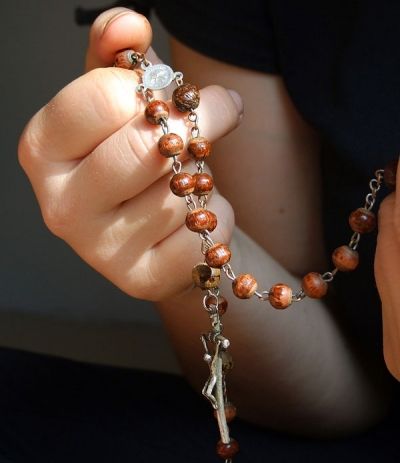
Because praying the Rosary involves repetitive prayer, it’s a good idea to have a rosary. If you don’t have a religious goods store in your area, you can find several sources on the Internet, some of which even offer free rosaries.

There are two basic ways to pray the Rosary, alone or with one or more people. If you are praying the Rosary with others, the custom is for one person to lead the group, primarily by saying the first half of each prayer and announcing each of the mysteries. 

For simplicity’s sake, we’ll assume here that you are praying the Rosary by yourself. If you join a group, most likely many of those present will understand how to pray the Rosary as a group, so all you’ll need to do is follow along. 

When praying the Rosary alone, you may either recite the prayers aloud or say them silently - it’s up to you.

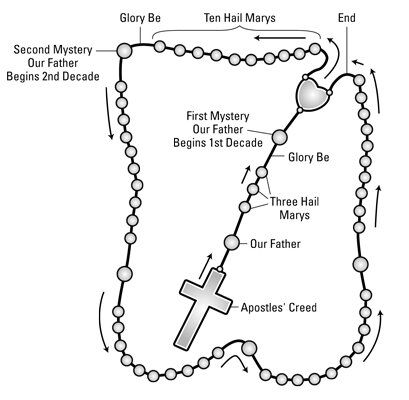
The rosary consists of six Our Father beads and five decades (sets of ten) Hail Mary Beads plus one set of three Hail Mary beads. The Apostles’ Creed is said on the crucifix, and the Glory Be is said on the chain or knot after each set of Hail Marys. The Hail, Holy Queen is said at the end of the Rosary. Here’s how to go about it. You may be surprised when you see how easy it really is: 

MAKE THE SIGN OF THE CROSS 

You begin the Rosary by making the sign of the cross using the small crucifix on the rosary. Simply hold the crucifix on your rosary with your fingers and trace the sign of the cross on your forehead, your chest, and then your left and right shoulders while saying,

In the name of the Father [forehead], and of the Son [chest], and of the Holy [left shoulder] Spirit [right shoulder]. Amen.

Say the Apostles’ Creed

Still holding the crucifix, pray the Apostles’ CREED:

I believe in God, the Father almighty, Creator of heaven and earth, and in Jesus Christ, his only Son, our Lord, who was conceived by the Holy Spirit, born of the Virgin Mary, suffered under Pontius Pilate, was crucified, died, and was buried. He descended into hell. The third day he rose again from the dead. He ascended into heaven and is seated at the right hand of the Father. From thence he shall come to judge the living and the dead. I believe in the Holy Spirit, the holy Catholic Church, the communion of saints, the forgiveness of sins, the resurrection of the body, and life everlasting. Amen.

Say the OUR FATHER 

Holding the first bead of your rosary (the bead closest to the crucifix), pray the Our Father:

Our Father, who art in heaven, hallowed be thy name. Thy kingdom come. Thy will be done, on earth as it is in heaven. Give us this day our daily bread. And forgive us our trespasses as we forgive those who trespass against us. And lead us not into temptation but deliver us from evil. Amen.

(If you came, or are coming, to Catholicism from a Protestant tradition, remember that Catholics say a doxology - "For the kingdom, and the power, and the glory are yours now and forever" - only in the context of the Mass, and then it is separated from the Our Father by a prayer said by the priest.)

Say Three HAIL MARY's

Next, hold each of the three beads in the next series one at a time, and pray a Hail Mary for each bead:

Hail, Mary, full of grace, the Lord is with thee (you). Blessed art thou (are you) among women, and blessed is the fruit of thy (your) womb, Jesus. Holy Mary, mother of God, pray for us sinners, now and at the hour of our death. Amen.

Say the GLORY BE / DOXOLOGY 

Holding the chain or knot that comes after the series of three Hail Mary beads, pray the Glory Be:

Glory be to the Father, and to the Son, and to the Holy Spirit. As it was in the beginning, it is now and ever shall be, world without end. (now and forever.) Amen.

If you like, you can say the following lines at the end of each Glory Be:

O my Jesus, forgive us our sins, save us from the fires of hell, and lead all souls to heaven, especially those in most need of thy (your) mercy. Amen.

It’s up to you whether you use this prayer, or not. If it appeals to you, go ahead and say it. If not, skip it.

SAY THE FIVE DECADES 

The next set of prayers, consisting of an OUR FATHER, 10 (ten) HAIL MARY's , and a GLORY BE - is repeated five times, once for each mystery of the Rosary. While holding the next, single bead, announce the first mystery of the kind you are praying today - joyful, sorrowful, glorious, or luminous. 

For example, "The first joyful mystery, the annunciation." Theoretically, the idea is to meditate or reflect upon this mystery while praying an Our Father, ten Hail Marys, and a Glory Be. If you can do that, great. If not, don’t worry about it. Personally, I suspect that the repetitive nature of the Rosary actually short-circuits conscious reflection on anything - let alone a mystery of faith - and acts something like a mantra does in the meditation methods of Zen Buddhism. 

The Rosary gives the fingers and tongue something to do, so that your mind and heart can "go deep," as it were, in wordless prayer.

After announcing the first mystery, and still holding the single bead, pray the Our Father. 

For each of the ten beads in the first decade of the Rosary, say one Hail Mary. 

When you reach the chain or knot after the tenth Hail Mary bead, say one Glory Be. 

Then hold the next single bead, announce the next mystery, say an Our Father, say the next set of ten Hail Marys, and say another Glory Be. 

Do this until you finish all five decades.

Say the HAIL, HOLY QUEEN / SALVE REGINA 

When you have completed the fifth decade of the Rosary and said the final Glory Be, say the HAIL, HOLY QUEEN :

Hail, Holy Queen, Mother of Mercy, our life, our sweetness, and our hope! To thee (you) do we cry, poor banished children of Eve; (the children of Eve;) to thee (you) do we send up our sighs, mourning and weeping in this vale (valley) of tears. (in this land of exile.) Turn then, most gracious advocate, thine (your) eyes of mercy toward us; and after this our exile, (lead us home at last and) show unto us the blessed fruit of thy (your) womb, Jesus. O clement, O loving, O sweet Virgin Mary. 

If you wish, you may also add this final verse-and-response prayer:

V: Pray for us, O holy mother of God,

R: That we may be made worthy of the promises of Christ.

And that’s it. That’s all there is to praying the Rosary. After you have prayed the Rosary a few times, you’ll know how easy it is. The more you pray the Rosary, however, the deeper you’ll get into it and the more you’ll discover its spiritual riches.


Thursday, October 22, 2020

NOTES TO MYSELF - by Hugh Prather


NOTES  TO  MYSELF  


 by  Hugh  Prather


It is sometimes said that each of us is ultimately alone. This idea is compelling not because of birth and death, but because so often our moments alone seem more true, more real.  

I need solitude like I need food and rest, and like eating and resting, solitude is most healing when it fits the rhythm of my needs.  A rigidly scheduled aloneness
does not nourish me. 

Solitude is perhaps a misnomer.  To me, being alone means togetherness - the re-coming-togetherness of myself and nature, of myself and being, the reuniting of myself with all other selves.  

Solitude especially means putting the parts of my mind back together, unifying the pieces of my mind back together, unifying the pieces of myself scattered by anger and fear, until I can once again see that the little things are little and the big things are big.


Saturday, October 17, 2020

IF YOU'RE GOING TO LOVE ME - by Anonymous


IF  YOU'RE  GOING  TO  LOVE  ME

by Anonymous

If you're ever going to love me love me now, while I can know
All the sweet and tender feelings which from real affection flow.
Love me now, while I am living; do not wait till I am gone
And then chisel it in marble  - warm love words on ice-cold stone.
If you've dear, sweet thoughts about me, why not whisper them to me?
Don't you know 'twould make me happy and as glad as glad could be?
If you wait till I am sleeping, ne'er to waken here again,
There'll be walls of earth between us and I couldn't hear you then.
If you knew someone was thirsting for a drop of water sweet
Would you be so slow to bring it? Would you step with laggard feet?
There are tender hearts all round us who are thirsting for our love;
Why withhold from them what nature makes them crave all else above?
I won't need your kind caresses when the grass grows o'er my face;
I won't crave your love or kisses in my last low resting place.
So, then, if you love me any, if it's but a little bit,
Let me know it now while living; I can own and treasure it.


Thursday, October 15, 2020

NERVES AND COMMON SENSE - by Annie Payson Call


https://kbimages1-a.akamaihd.net/7e76d9b5-b76a-42b9-a0ee-48175cb40ab2/1200/1200/False/nerves-and-common-sense-12.jpg


PLAIN  EVERY DAY  COMMON  SENSE


Plain common sense! When we come to sift everything down which will enable us to live wholesome, steady, every day, interesting lives, plain common sense seems to be the first and the simplest need. In the working out of any problem, whether it be in science or in art or in plain everyday living, we are told to go from the circumference to the center, from the known to the unknown, from simplest facts to those which would otherwise seem complex. And whether the life we are living is quiet and commonplace, or whether it is full of change and adventure, to be of the greatest and most permanent use, a life must have as its habitual background plain every day common sense.

When we stop and think a while, the lack of this important quality is quite glaring, and every one who has his attention called to it and recognizes that lack enough to be interested to supply it in his own life, is doing more good toward bringing plain common sense into the world at large than we can well appreciate. For instance, it is only a fact of plain common sense that we should keep rested, and yet how many of us do? How many readers of this article will smile or sneer, or be irritated when they read the above, and say, "It is all very well to talk of keeping rested. How is it possible with all I have to do ? or with all the care I have? or with all I have to worry me ?"

Now that is just the point, the answer to that question, "How is it possible ?" So very few of us know how to do it, and if "how to keep rested though busy" were regularly taught in all schools in this country, so far from making the children self conscious and over careful of themselves, it would lay up in their brains ideas of plain common sense which would be stocked safely there for use when, as their lives grew more maturely busy, they would find the right habits formed, enabling them to keep busy and at the same time to keep quiet and rested. What a wonderful difference it would eventually make in the wholesomeness of the manners and customs of this entire nation. And that difference would come from giving the children now a half hour's instruction in the plain common sense of keeping well rested, and in seeing that such instruction was entirely and only practical.

It has often seemed to me that the tendency of education in the present day is more toward giving information than it is in preparing the mind to receive and use interesting and useful information of all kinds: that is, in helping the mind to attract what it needs; to absorb what it attracts, and digest what it absorbs as thoroughly as any good healthy stomach ever digested the food it needed to supply the body with strength. The root of such cultivation, it seems to me, is in teaching the practical use and application of all that is studied. To be sure, there is much more of that than there was fifty years ago, but you have only to put to the test the minds of young graduates to see how much more of such work is needed, and how much more intelligent the training of the young mind may be, even now.

Take, for instance, the subject of ethics. How many boys and girls go home and are more useful in their families, more thoughtful and considerate for all about them, for their study of ethics in school ? And yet the study of ethics has no other use than this. If the mind absorbed and digested the true principles of ethics, so that the heart felt moved to use them, it might, it probably would make a great change in the lives of the boys and girls who studied it, a change that would surprise and delight their parents and friends.

If the science of keeping rested were given in schools in the way that, in most cases, the science of ethics seems to be given now, the idea of rest would lie in an indigestible lump on the minds of the students, and instead of being absorbed, digested and carried out in their daily lives, would be evaporated little by little into the air, or vomited off the mind in various jokes about it, and other expressions that would prove the children knew nothing of what they were being taught.

But again, I am glad to repeat if instruction, practical instruction, were given every day in the schools on how to form the habit of keeping rested, it would have a wonderful effect upon the whole country, not to mention where in many individual cases it would actually prevent the breaking out of hereditary disease.

Nature always tends toward health; so strongly, so habitually does nature tend toward health that it seems at times as if the working of natural laws pushed some people into health in spite of chronic antagonism they seem to have against health, one might even say in spite of the wilful refusal of health.

When one's body is kept rested, nature is constantly throwing off germs of disease, constantly working, and working most actively, to protect the body from anything that would interfere with its perfect health. When one's body is not rested, nature works just as hard, but the tired body through its various forms of tension that impede the circulation, prevent the healthy absorption of food and oxygen, and clog the way so that impurities cannot be carried off, interferes with nature's work and thus makes it impossible for her to keep the machine well oiled. When we are tired, the very fact of being tired makes us more tired, unless we rest properly.

A great deal - it seems to me more than one half - of the fatigue in the world comes from the need of an intelligent understanding of how to keep rested. The more that lack of intelligence is allowed to grow, the worse it is going to be for the health of the nation. We have less of that plain common sense than our grandfathers and grandmothers. They had less than their fathers and mothers. We need more than our ancestors, because life is more complicated now, than it was then. We can get more if we will, because there is more real understanding of the science of hygiene than our fathers and mothers had before us. Our need now is to use practically the information which a few individuals are able to give us, and especially to teach such practical use to our children.

Let us find out how we would actually go to work to keep rested, and take the information of plain common sense and use it.

To keep rested we must not overwork our body inside or outside. We must keep it in an equilibrium of action and rest.

We overwork our body inside when we eat the wrong food and when we eat too much or not enough of the right food, for then the stomach has more than its share of work to do, and as the effort to do it well robs the brain and the whole nervous system, so, of course, the rest of the body has not its rightful supply of energy and the natural result is great fatigue.

We overwork our body inside when we do not give it its due amount of fresh air. The blood needs the oxygen to supply itself and the nerves and muscles with power to do their work. When the oxygen is not supplied to the blood, the machinery of the body has to work with so much less power than really belongs to it, that there is great strain in the effort to do its work properly, and the effect is, of course, fatigue.

In either of the above cases, both with an overworked stomach and an overworked heart and lungs, the complaint is very apt to be, "Why am I so tired when I have done nothing to get tired?" The answer is, "No, you have done nothing outside with your muscles, but the heart and lungs and the stomach are delicate and exquisite instruments. You have overworked them all, and such overwork is the more fatiguing in proportion to what is done than any other form, except overwork of the brain." And the overtired stomach and heart and lungs tire the brain, of course.

Of the work that is given to the brain itself to overtire it we must speak later. So much now for that which prevents the body from keeping rested inside, in the finer working of its machinery.

It is easy to find out what and how to eat. A very little careful thought will show us that. It is only the plain common sense of eating we need. It is easy to see that we must not eat on a tired stomach, and if we have to do so, we must eat much less than we ordinarily would, and eat it more slowly. So much good advice is already given about what and how to eat, I need say nothing here, and even without that advice, which in itself is so truly valuable, most of us could have plain common sense about our own food if we would use our minds intelligently about it, and eat only what we know to be nourishing to us. That can be done without fussing. Fussing about food contracts the stomach, and prevents free digestion almost as much as eating indigestible food.

Then again, if we deny ourselves that which we want and know is bad for us, and eat only that which we know to be nourishing, it increases the delicacy of our relish. We do not lose relish by refusing to eat too much candy. We gain it. Human pigs lose their most delicate relish entirely, and they lose much, very much more, than that.

Unfortunately with most people, there is not the relish for fresh air that there is for food. Very few people want fresh air selfishly; the selfish tendency of most people is to cut it off for fear of taking cold. And yet the difference felt in health, in keeping rested, in ease of mind, is as great between no fresh air and plenty of fresh air as it is between the wrong kind of food and enough (and not too much) of the right kind of food.

Why does not the comfort of the body appeal to us as strongly through the supply of air given to the lungs as through that of food given to the stomach? The right supply of fresh air has such wonderful power to keep us rested!

Practical teaching to the children here would, among other things, give them training which would open their lungs and enable them to take in with every breath the full amount of oxygen needed toward keeping them rested. There are so many cells in the lungs of most people, made to receive oxygen, which never receive one bit of the food they are hungry for.

There is much more, of course, very much more, to say about the working of the machinery of the inside of the body and about the plain common sense needed to keep it well and rested, but I have said enough for now to start a thoughtful mind to work.

Now for keeping the body well rested from the outside. It is all so well arranged for us, the night given us to sleep in, a good long day of work and a long night of rest; so the time for rest and the time for work are equalized and it is so happily arranged that out of the twenty-four hours in the day, when we are well, we need only eight hours' sleep. So well does nature work and so truly that she can make up for us in eight hours' sleep what fuel we lose in sixteen hours of activity.

Only one-third of the time do we need to sleep, and we have the other two-thirds for work and play. This regular sleep is a strong force in our aim to keep rested. Therefore, the plain common sense of that is to find out how to go to sleep naturally, how to get all the rest out of sleep that nature would give us, and so to wake refreshed and ready for the day.

To go to sleep naturally we must learn how to drop all the tension of the day and literally drop to sleep like a baby. Let go into sleep, there is a host of meaning in that expression. When we do that, nature can revive and refresh and renew us. Renew our vitality, bring us so much more brain power for the day, all that we need for our work and our play; or almost all, for there are many little rests during the day, little openings for rest that we need to take, and that we can teach ourselves to take as a matter of course. We can sit restfully at each one of our three meals. Eat restfully and quietly, and so make each meal not only a means of getting nourishment, but of getting rest as well. There is all the difference of illness and health in taking a meal with strain and a sense of rush and pressure of work, and in taking it as if to eat that one meal were the only thing we had to do in the day. Better to eat a little nourishing food and eat it quietly and at leisure than a large meal of the same food with a sense of rush. This is a very important factor in keeping rested.

Then there are the many expected and unexpected times in the day when we can take rest and so keep rested. If we have to wait we can sit quietly. Whatever we are doing we can make use of the between times to rest. Each man can find his own "between times." If we make real use of them, intelligent use, they not only help us to keep rested, they help us to do our work better, if we will but watch for them and use them.

Now the body is only a servant, and in all I have written above, I have only written of the servant. How can a servant keep well and rested if the master drives him to such an extent that he is brought into a state, not where he won't go, but where he can't go, and must therefore drop ? It is the intelligent master, who is a true disciple of plain common sense, who will train his servant, the body, in the way of resting, eating and breathing, in order to fit it for the maximum of work at the minimum of energy. But if you obey every external law for the health and strength of the body, and obey it implicitly, and to the letter, with all possible intelligence, you cannot keep it healthy if the mind that owns the body is pulling it and twisting it, and twanging on its delicate machinery with a flood of resentment and resistance; and the spirit behind the mind is eager, wretched, and unhappy, because it does not get its own way, or elated with an inflamed egoism because it is getting its own way.

All plain common sense in the way of health for the body falls dead unless followed up closely with plain common sense for the health of the mind; and then again, although when there is "a healthy mind in a healthy body," the health appears far more permanent than when a mind full of personal resistance tries to keep its body healthy, even that happy combination cannot be really permanent unless there is found back of it a healthy spirit.

But of the plain common sense of the spirit there is more to be said at another time.

With regard to the mind, let us look and see not only that it is not sensible to allow it to remain full of resistance, but is it not positively stupid ?

What an important factor it should be in the education of children to teach them the plain common sense needed to keep the mind healthy to teach them the uselessness of a mental resistance, and the wholesomeness of a clean mind.

If a child worries about his lessons, he is resisting the possibility of failing in his class; let him learn that the worry interferes with his getting his lesson. Teach him how to drop the worry, and he will find not only that he gets the lesson in less time, but his mind is clearer to remember it.

By following the same laws, children could be taught that a feeling of rush and hurry only impedes their progress. The rushed feeling sometimes comes from a nervous unquiet which is inherited, and should be trained out of the child.

But alas! alas! how can a mother or a father train a child to live common sensibly without useless resistance when neither the mother nor the father can do that same themselves. It is not too late for any mother or father to learn, and if each will have the humility to confess to the child that they are learning and help the child to learn with them, no child would or could take advantage of that and as the children are trained rightly, what a start they can give their own children when they grow up and what a gain there might be from one generation to another ! Will it ever come ? Surely we hope so.


A  SUMMING  UP


Give up resentment, give up unhealthy resistance.

If circumstances, or persons, arouse either resentment or resistance in us, let us ignore the circumstances or persons until we have quieted ourselves. Freedom does not come from merely yielding out of resentment or unhealthy resistance, it comes also from the strong and steady focus on such yielding. Concentration and relaxation are just as necessary one to another to give stability to the nerves of a man as the centrifugal and centripetal forces are necessary to give stability to the Earth.

As the habit of healthy concentration and relaxation grows within us, our perception clears so that we see what is right to do, and are given the power to do it. As our freedom from bondage to our fellowmen becomes established, our relation to our fellowmen grows happier, more penetrating and more full of life, and later we come to understand that at root it is ourselves, our own resentment and resistance to which we have been in bondage, circumstances or other people have had really nothing to do with it. When we have made that discovery, and are steadily acting upon it, we are free indeed, and with this new liberty there grows a clear sense and conviction of a wise, loving Power which, while leaving us our own free will, is always tenderly guiding us.

No one ever really believed anything without experiencing it. We may think we believe all sorts of beautiful truths, but how can any truth be really ours unless we have proved it by living ? We do not fully believe it until it runs in our blood that is - we must see a truth with our minds, love it with our hearts and live it over and over again in our lives before it is ours.

If the reader will think over this little book, he will see that every chapter has healthy yielding at the root of it. It is a constant repetition of the same principle applied to the commonplace circumstances of life, and if the reader will take this principle into his mind, and work practically to live it in his life, he will find the love for it growing in his heart, and with it a living conviction that when truly applied, it always works.

Some one once described the difference between good breeding and bad breeding as that between a man who works as a matter of course to conquer his limitations and a man to whom his limitations are inevitable.

There is spiritual good breeding and natural good breeding. The first comes from the achievement of personal character the second is born with us to use or misuse as we prefer.

It is a happy thing to realize that our freedom from bondage to circumstances, and our loving, intelligent freedom from other people, is the true spiritual good breeding which gives vitality to every action of our lives, and brings us into more real and closer touch with our fellow men. Courtesy is alive when it has genuine love of all human nature at the root of it, it is dead when it is merely a matter of good form.

In so far as I know, the habit of such freedom and good breeding cannot be steadily sustained without an absolute, conscious dependence upon the Lord God Almighty.

https://facts.kiddle.co/images/thumb/4/4d/Portrait_of_Annie_Payson_Call.jpg/300px-Portrait_of_Annie_Payson_Call.jpg

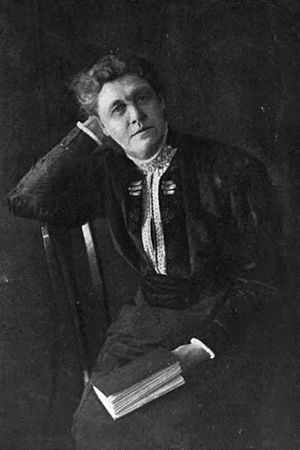
Annie Payson Call (1853–1940) was a Waltham author. 

She wrote several books and published articles in "Ladies' Home Journal".

Many articles are reprinted in her book "Nerves and Common Sense".

The common theme of her work is mental health. 


80383e42cd73a7dcd4751f8b798bcdb81f7433255d38b9536ce2165c63c46629.png


Wednesday, September 16, 2020

GIFTS AND PRESENTS - by Aufie Zophy


 GIFTS  AND  PRESENTS

by  Aufie Zophy


Isn’t it always fun and pleasant
To receive a wonderful present
Wrapped in paper and ribbons of gold
A gift of value and beauty untold


Unexpected or on a special event
Received from a brother or friend
Such gifts make us really feel good
They have to power to change our mood

Now in your heart and mind,
think about gifts of another kind
of presents that are floating in the air
forever and always there.


Everyday we get such gifts for free
Think just about all the beauty we see
The peace we find at dawn in our room
The song of a bird, a marvellous tune


There is so much in nature to be adored
Which gets all too often simply ignored
So is also the love that sits in our heart
And the creativity, our sense for art.


The love sits in our heart; be always aware:
It is replenished no matter how much we share
Sharing love, the greatest gift we get from God
But all too often we appreciate it not.


Creativity another gift from above
As valuable for our character as love.
Using our talents as well as we can
for helping any other woman or man


Most of the gifts of nature are always there
We just need to open our heart and let it in
Love and creativity in abundance to share
So let’s all be aware and live a life from within


Thursday, July 30, 2020

THE YELLOW WALLPAPER - by Charlotte Perkins Gilman


https://i.pinimg.com/originals/e0/dc/4f/e0dc4fafda953ba35b03c04cba43a678.jpg


It is very seldom that mere ordinary people like John and myself secure ancestral halls for the summer.

A colonial mansion, a hereditary estate, I would say a haunted house, and reach the height of romantic felicity but that would be asking too much of fate!

Still I will proudly declare that there is something queer about it.

Else, why should it be let so cheaply? And why have stood so long untenanted?

John laughs at me, of course, but one expects that in marriage.

John is practical in the extreme. He has no patience with faith, an intense horror of superstition, and he scoffs openly at any talk of things not to be felt and seen and put down in figures.

John is a physician, and perhaps - (I would not say it to a living soul, of course, but this is dead paper and a great relief to my mind) - perhaps that is one reason I do not get well faster.

You see, he does not believe I am sick!

And what can one do?

If a physician of high standing, and one’s own husband, assures friends and relatives that there is really nothing the matter with one but temporary nervous depression, a slight hysterical tendency, what is one to do?

My brother is also a physician, and also of high standing, and he says the same thing.

So I take phosphates or phosphites, whichever it is, and tonics, and journeys, and air, and exercise, and am absolutely forbidden to “work” until I am well again.

Personally, I disagree with their ideas.

Personally, I believe that congenial work, with excitement and change, would do me good.

But what is one to do?

I did write for a while in spite of them; but it does exhaust me a good deal - having to be so sly about it, or else meet with heavy opposition.

I sometimes fancy that in my condition if I had less opposition and more society and stimulus but John says the very worst thing I can do is to think about my condition, and I confess it always makes me feel bad.

So I will let it alone and talk about the house.

The most beautiful place! It is quite alone, standing well back from the road, quite three miles from the village. It makes me think of English places that you read about, for there are hedges and walls and gates that lock, and lots of separate little houses for the gardeners and people.

There is a delicious garden! I never saw such a garden large and shady, full of box-bordered paths, and lined with long grape-covered arbors with seats under them.

There were greenhouses, too, but they are all broken now.

There was some legal trouble, I believe, something about the heirs and co-heirs; anyhow, the place has been empty for years.

That spoils my ghostliness, I am afraid; but I don’t care, there is something strange about the house, I can feel it.

I even said so to John one moonlight evening, but he said what I felt was a draught, and shut the window.

I get unreasonably angry with John sometimes. I’m sure I never used to be so sensitive. I think it is due to this nervous condition.

But John says if I feel so I shall neglect proper self-control; so I take pains to control myself, before him, at least, and that makes me very tired.

I don’t like our room a bit. I wanted one downstairs that opened on the piazza and had roses all over the window, and such pretty old-fashioned chintz hangings! but John would not hear of it.

He said there was only one window and not room for two beds, and no near room for him if he took another.

He is very careful and loving, and hardly lets me stir without special direction.

I have a schedule prescription for each hour in the day; he takes all care from me, and so I feel basely ungrateful not to value it more.

He said we came here solely on my account, that I was to have perfect rest and all the air I could get. “Your exercise depends on your strength, my dear,” said he, “and your food somewhat on your appetite; but air you can absorb all the time.” So we took the nursery, at the top of the house.

It is a big, airy room, the whole floor nearly, with windows that look all ways, and air and sunshine galore. It was nursery first and then playground and gymnasium, I should judge; for the windows are barred for little children, and there are rings and things in the walls.

The paint and paper look as if a boys’ school had used it. It is stripped off the paper in great patches all around the head of my bed, about as far as I can reach, and in a great place on the other side of the room low down. I never saw a worse paper in my life.

One of those sprawling flamboyant patterns committing every artistic sin.

It is dull enough to confuse the eye in following, pronounced enough to constantly irritate, and provoke study, and when you follow the lame, uncertain curves for a little distance they suddenly commit suicide plunge off at outrageous angles, destroy themselves in unheard of contradictions.

The color is repellant, almost revolting; a smouldering, unclean yellow, strangely faded by the slow-turning sunlight.

It is a dull yet lurid orange in some places, a sickly sulphur tint in others.

No wonder the children hated it! I should hate it myself if I had to live in this room long.

There comes John, and I must put this away, he hates to have me write a word.

***

We have been here two weeks, and I haven’t felt like writing before, since that first day.

I am sitting by the window now, up in this atrocious nursery, and there is nothing to hinder my writing as much as I please, save lack of strength.

John is away all day, and even some nights when his cases are serious.

I am glad my case is not serious!

But these nervous troubles are dreadfully depressing.

John does not know how much I really suffer. He knows there is no reason to suffer, and that satisfies him.

Of course it is only nervousness. It does weigh on me so not to do my duty in any way!

I meant to be such a help to John, such a real rest and comfort, and here I am a comparative burden already!

Nobody would believe what an effort it is to do what little I am able to dress and entertain, and order things.

It is fortunate Mary is so good with the baby. Such a dear baby!

And yet I cannot be with him, it makes me so nervous.

I suppose John never was nervous in his life. He laughs at me so about this wallpaper!

At first he meant to repaper the room, but afterwards he said that I was letting it get the better of me, and that nothing was worse for a nervous patient than to give way to such fancies.

He said that after the wallpaper was changed it would be the heavy bedstead, and then the barred windows, and then that gate at the head of the stairs, and so on.

“You know the place is doing you good,” he said, “and really, dear, I don’t care to renovate the house just for a three months’ rental.”

“Then do let us go downstairs,” I said, “there are such pretty rooms there.”

Then he took me in his arms and called me a blessed little goose, and said he would go down cellar if I wished, and have it whitewashed into the bargain.

But he is right enough about the beds and windows and things.

It is as airy and comfortable a room as any one need wish, and, of course, I would not be so silly as to make him uncomfortable just for a whim.

I’m really getting quite fond of the big room, all but that horrid paper.

Out of one window I can see the garden, those mysterious deep shaded arbors, the riotous old-fashioned flowers, and bushes and gnarly trees.

Out of another I get a lovely view of the bay and a little private wharf belonging to the estate. There is a beautiful shaded lane that runs down there from the house. I always fancy I see people walking in these numerous paths and arbors, but John has cautioned me not to give way to fancy in the least. He says that with my imaginative power and habit of story-making a nervous weakness like mine is sure to lead to all manner of excited fancies, and that I ought to use my will and good sense to check the tendency. So I try.

I think sometimes that if I were only well enough to write a little it would relieve the press of ideas and rest me.

But I find I get pretty tired when I try.

It is so discouraging not to have any advice and companionship about my work. When I get really well John says we will ask Cousin Henry and Julia down for a long visit; but he says he would as soon put fireworks in my pillow case as to let me have those stimulating people about now.

I wish I could get well faster.

But I must not think about that. This paper looks to me as if it knew what a vicious influence it had!

There is a recurrent spot where the pattern lolls like a broken neck and two bulbous eyes stare at you upside-down.

I get positively angry with the impertinence of it and the everlastingness. Up and down and sideways they crawl, and those absurd, unblinking eyes are everywhere. There is one place where two breadths didn’t match, and the eyes go all up and down the line, one a little higher than the other.

I never saw so much expression in an inanimate thing before, and we all know how much expression they have! I used to lie awake as a child and get more entertainment and terror out of blank walls and plain furniture than most children could find in a toy-store.

I remember what a kindly wink the knobs of our big old bureau used to have, and there was one chair that always seemed like a strong friend.

I used to feel that if any of the other things looked too fierce I could always hop into that chair and be safe.

The furniture in this room is no worse than inharmonious, however, for we had to bring it all from downstairs. I suppose when this was used as a playroom they had to take the nursery things out, and no wonder! I never saw such ravages as the children have made here.

The wallpaper, as I said before, is torn off in spots, and it sticketh closer than a brother they must have had perseverance as well as hatred.

Then the floor is scratched and gouged and splintered, the plaster itself is dug out here and there, and this great heavy bed, which is all we found in the room, looks as if it had been through the wars.

But I don’t mind it a bit only the paper.

There comes John’s sister. Such a dear girl as she is, and so careful of me! I must not let her find me writing.

She is a perfect, and enthusiastic housekeeper, and hopes for no better profession. I verily believe she thinks it is the writing which made me sick!

But I can write when she is out, and see her a long way off from these windows.

There is one that commands the road, a lovely, shaded, winding road, and one that just looks off over the country. A lovely country, too, full of great elms and velvet meadows.

This wallpaper has a kind of sub-pattern in a different shade, a particularly irritating one, for you can only see it in certain lights, and not clearly then.

But in the places where it isn’t faded, and where the sun is just so, I can see a strange, provoking, formless sort of figure, that seems to sulk about behind that silly and conspicuous front design.

There’s sister on the stairs!

***

Well, the Fourth of July is over! The people are gone and I am tired out. John thought it might do me good to see a little company, so we just had mother and Nellie and the children down for a week.

Of course I didn’t do a thing. Jennie sees to everything now.

But it tired me all the same.

John says if I don’t pick up faster he shall send me to Weir Mitchell in the fall.

But I don’t want to go there at all. I had a friend who was in his hands once, and she says he is just like John and my brother, only more so!

Besides, it is such an undertaking to go so far.

I don’t feel as if it was worth while to turn my hand over for anything, and I’m getting dreadfully fretful and querulous.

I cry at nothing, and cry most of the time.

Of course I don’t when John is here, or anybody else, but when I am alone.

And I am alone a good deal just now. John is kept in town very often by serious cases, and Jennie is good and lets me alone when I want her to.

So I walk a little in the garden or down that lovely lane, sit on the porch under the roses, and lie down up here a good deal.

I’m getting really fond of the room in spite of the wallpaper. Perhaps because of the wallpaper.

It dwells in my mind so!

I lie here on this great immovable bed, it is nailed down, I believe and follow that pattern about by the hour. It is as good as gymnastics, I assure you. I start, we’ll say, at the bottom, down in the corner over there where it has not been touched, and I determine for the thousandth time that I will follow that pointless pattern to some sort of a conclusion.

I know a little of the principle of design, and I know this thing was not arranged on any laws of radiation, or alternation, or repetition, or symmetry, or anything else that I ever heard of.

It is repeated, of course, by the breadths, but not otherwise.

Looked at in one way each breadth stands alone, the bloated curves and flourishes a kind of “debased Romanesque” with delirium tremens go waddling up and down in isolated columns of fatuity.

But, on the other hand, they connect diagonally, and the sprawling outlines run off in great slanting waves of optic horror, like a lot of wallowing seaweeds in full chase.

The whole thing goes horizontally, too, at least it seems so, and I exhaust myself in trying to distinguish the order of its going in that direction.

They have used a horizontal breadth for a frieze, and that adds wonderfully to the confusion.

There is one end of the room where it is almost intact, and there, when the cross-lights fade and the low sun shines directly upon it, I can almost fancy radiation after all, the interminable grotesques seem to form around a common centre and rush off in headlong plunges of equal distraction.

It makes me tired to follow it. I will take a nap, I guess.

***

I don’t know why I should write this.

I don’t want to.

I don’t feel able.

And I know John would think it absurd. But I must say what I feel and think in some way it is such a relief!

But the effort is getting to be greater than the relief.

Half the time now I am awfully lazy, and lie down ever so much.

John says I musn’t lose my strength, and has me take cod-liver oil and lots of tonics and things, to say nothing of ale and wine and rare meat.

Dear John! He loves me very dearly, and hates to have me sick. I tried to have a real earnest reasonable talk with him the other day, and tell him how I wish he would let me go and make a visit to Cousin Henry and Julia.

But he said I wasn’t able to go, nor able to stand it after I got there; and I did not make out a very good case for myself, for I was crying before I had finished.

It is getting to be a great effort for me to think straight. Just this nervous weakness, I suppose.

And dear John gathered me up in his arms, and just carried me upstairs and laid me on the bed, and sat by me and read to me till it tired my head.

He said I was his darling and his comfort and all he had, and that I must take care of myself for his sake, and keep well.

He says no one but myself can help me out of it, that I must use my will and self control and not let any silly fancies run away with me.

There’s one comfort, the baby is well and happy, and does not have to occupy this nursery with the horrid wallpaper.

If we had not used it that blessed child would have! What a fortunate escape! Why, I wouldn’t have a child of mine, an impressionable little thing, live in such a room for worlds.

I never thought of it before, but it is lucky that John kept me here after all. I can stand it so much easier than a baby, you see.

Of course I never mention it to them any more, I am too wise, but I keep watch of it all the same.

There are things in that paper that nobody knows but me, or ever will.

Behind that outside pattern the dim shapes get clearer every day.

It is always the same shape, only very numerous.

And it is like a woman stooping down and creeping about behind that pattern. I don’t like it a bit. I wonder, I begin to think, I wish John would take me away from here!

***

It is so hard to talk with John about my case, because he is so wise, and because he loves me so.

But I tried it last night.

It was moonlight. The moon shines in all around, just as the sun does.

I hate to see it sometimes, it creeps so slowly, and always comes in by one window or another.

John was asleep and I hated to waken him, so I kept still and watched the moonlight on that undulating wallpaper till I felt creepy.

The faint figure behind seemed to shake the pattern, just as if she wanted to get out.

I got up softly and went to feel and see if the paper did move, and when I came back John was awake.

“What is it, little girl?” he said. “Don’t go walking about like that you’ll get cold.”

I thought it was a good time to talk, so I told him that I really was not gaining here, and that I wished he would take me away.

“Why darling!” said he, “our lease will be up in three weeks, and I can’t see how to leave before.

“The repairs are not done at home, and I cannot possibly leave town just now. Of course if you were in any danger I could and would, but you really are better, dear, whether you can see it or not. I am a doctor, dear, and I know. You are gaining flesh and color, your appetite is better. I feel really much easier about you.”

“I don’t weigh a bit more,” said I, “nor as much; and my appetite may be better in the evening, when you are here, but it is worse in the morning when you are away.”

“Bless her little heart!” said he with a big hug; “she shall be as sick as she pleases! But now let’s improve the shining hours by going to sleep, and talk about it in the morning!”

“And you won’t go away?” I asked gloomily.

“Why, how can I, dear? It is only three weeks more and then we will take a nice little trip of a few days while Jennie is getting the house ready. Really, dear, you are better!”

“Better in body perhaps” I began, and stopped short, for he sat up straight and looked at me with such a stern, reproachful look that I could not say another word.

“My darling,” said he, “I beg of you, for my sake and for our child’s sake, as well as for your own, that you will never for one instant let that idea enter your mind! There is nothing so dangerous, so fascinating, to a temperament like yours. It is a false and foolish fancy. Can you not trust me as a physician when I tell you so?”

So of course I said no more on that score, and we went to sleep before long. He thought I was asleep first, but I wasn’t, I lay there for hours trying to decide whether that front pattern and the back pattern really did move together or separately.

On a pattern like this, by daylight, there is a lack of sequence, a defiance of law, that is a constant irritant to a normal mind.

The color is hideous enough, and unreliable enough, and infuriating enough, but the pattern is torturing.

You think you have mastered it, but just as you get well under way in following, it turns a back somersault and there you are. It slaps you in the face, knocks you down, and tramples upon you. It is like a bad dream.

The outside pattern is a florid arabesque, reminding one of a fungus. If you can imagine a toadstool in joints, an interminable string of toadstools, budding and sprouting in endless convolutions, why, that is something like it.

That is, sometimes!

There is one marked peculiarity about this paper, a thing nobody seems to notice but myself, and that is that it changes as the light changes.

When the sun shoots in through the east window I always watch for that first long, straight ray it changes so quickly that I never can quite believe it.

That is why I watch it always.

By moonlight the moon shines in all night when there is a moon I wouldn’t know it was the same paper.

At night in any kind of light, in twilight, candlelight, lamplight, and worst of all by moonlight, it becomes bars! The outside pattern I mean, and the woman behind it is as plain as can be.

I didn’t realize for a long time what the thing was that showed behind, that dim sub-pattern, but now I am quite sure it is a woman.

By daylight she is subdued, quiet. I fancy it is the pattern that keeps her so still. It is so puzzling. It keeps me quiet by the hour.

I lie down ever so much now. John says it is good for me, and to sleep all I can.

Indeed, he started the habit by making me lie down for an hour after each meal.

It is a very bad habit, I am convinced, for, you see, I don’t sleep.

And that cultivates deceit, for I don’t tell them I’m awake, oh, no!

The fact is, I am getting a little afraid of John.

He seems very queer sometimes, and even Jennie has an inexplicable look.

It strikes me occasionally, just as a scientific hypothesis, that perhaps it is the paper!

I have watched John when he did not know I was looking, and come into the room suddenly on the most innocent excuses, and I’ve caught him several times looking at the paper! And Jennie too. I caught Jennie with her hand on it once.

She didn’t know I was in the room, and when I asked her in a quiet, a very quiet voice, with the most restrained manner possible, what she was doing with the paper she turned around as if she had been caught stealing, and looked quite angry asked me why I should frighten her so!

Then she said that the paper stained everything it touched, that she had found yellow smooches on all my clothes and John’s, and she wished we would be more careful!

Did not that sound innocent? But I know she was studying that pattern, and I am determined that nobody shall find it out but myself!

***

Life is very much more exciting now than it used to be. You see I have something more to expect, to look forward to, to watch. I really do eat better, and am more quiet than I was.

John is so pleased to see me improve! He laughed a little the other day, and said I seemed to be flourishing in spite of my wallpaper.

I turned it off with a laugh. I had no intention of telling him it was because of the wallpaper he would make fun of me. He might even want to take me away.

I don’t want to leave now until I have found it out. There is a week more, and I think that will be enough.

***

I’m feeling ever so much better! I don’t sleep much at night, for it is so interesting to watch developments; but I sleep a good deal in the daytime.

In the daytime it is tiresome and perplexing.

There are always new shoots on the fungus, and new shades of yellow all over it. I cannot keep count of them, though I have tried conscientiously.

It is the strangest yellow, that wallpaper! It makes me think of all the yellow things I ever saw not beautiful ones like buttercups, but old foul, bad yellow things.

But there is something else about that paper the smell! I noticed it the moment we came into the room, but with so much air and sun it was not bad. Now we have had a week of fog and rain, and whether the windows are open or not, the smell is here.

It creeps all over the house.

I find it hovering in the dining-room, skulking in the parlor, hiding in the hall, lying in wait for me on the stairs.

It gets into my hair.

Even when I go to ride, if I turn my head suddenly and surprise it there is that smell!

Such a peculiar odor, too! I have spent hours in trying to analyze it, to find what it smelled like.

It is not bad at first, and very gentle, but quite the subtlest, most enduring odor I ever met.

In this damp weather it is awful. I wake up in the night and find it hanging over me.

It used to disturb me at first. I thought seriously of burning the house to reach the smell.

But now I am used to it. The only thing I can think of that it is like is the color of the paper! A yellow smell.

There is a very funny mark on this wall, low down, near the mopboard. A streak that runs round the room. It goes behind every piece of furniture, except the bed, a long, straight, even smooch, as if it had been rubbed over and over.

I wonder how it was done and who did it, and what they did it for. Round and round and round, round and round and round it makes me dizzy!

***

I really have discovered something at last.

Through watching so much at night, when it changes so, I have finally found out.

The front pattern does move and no wonder! The woman behind shakes it!

Sometimes I think there are a great many women behind, and sometimes only one, and she crawls around fast, and her crawling shakes it all over.

Then in the very bright spots she keeps still, and in the very shady spots she just takes hold of the bars and shakes them hard.

And she is all the time trying to climb through. But nobody could climb through that pattern it strangles so; I think that is why it has so many heads.

They get through, and then the pattern strangles them off and turns them upside down, and makes their eyes white!

If those heads were covered or taken off it would not be half so bad.

***

I think that woman gets out in the daytime!

And I’ll tell you why, privately, I’ve seen her!

I can see her out of every one of my windows!

It is the same woman, I know, for she is always creeping, and most women do not creep by daylight.

I see her on that long shaded lane, creeping up and down. I see her in those dark grape arbors, creeping all around the garden.

I see her on that long road under the trees, creeping along, and when a carriage comes she hides under the blackberry vines.

I don’t blame her a bit. It must be very humiliating to be caught creeping by daylight!

I always lock the door when I creep by daylight. I can’t do it at night, for I know John would suspect something at once.

And John is so queer now, that I don’t want to irritate him. I wish he would take another room! Besides, I don’t want anybody to get that woman out at night but myself.

I often wonder if I could see her out of all the windows at once.

But, turn as fast as I can, I can only see out of one at one time.

And though I always see her she may be able to creep faster than I can turn!

I have watched her sometimes away off in the open country, creeping as fast as a cloud shadow in a high wind.

***

If only that top pattern could be gotten off from the under one! I mean to try it, little by little.

I have found out another funny thing, but I shan’t tell it this time! It does not do to trust people too much.

There are only two more days to get this paper off, and I believe John is beginning to notice. I don’t like the look in his eyes.

And I heard him ask Jennie a lot of professional questions about me. She had a very good report to give.

She said I slept a good deal in the daytime.

John knows I don’t sleep very well at night, for all I’m so quiet!

He asked me all sorts of questions, too, and pretended to be very loving and kind.

As if I couldn’t see through him!

Still, I don’t wonder he acts so, sleeping under this paper for three months.

It only interests me, but I feel sure John and Jennie are secretly affected by it.

***

Hurrah! This is the last day, but it is enough. John is to stay in town over night, and won’t be out until this evening.

Jennie wanted to sleep with me the sly thing! but I told her I should undoubtedly rest better for a night all alone.

That was clever, for really I wasn’t alone a bit! As soon as it was moonlight, and that poor thing began to crawl and shake the pattern, I got up and ran to help her.

I pulled and she shook, I shook and she pulled, and before morning we had peeled off yards of that paper.

A strip about as high as my head and half around the room.

And then when the sun came and that awful pattern began to laugh at me I declared I would finish it to-day!

We go away to-morrow, and they are moving all my furniture down again to leave things as they were before.

Jennie looked at the wall in amazement, but I told her merrily that I did it out of pure spite at the vicious thing.

She laughed and said she wouldn’t mind doing it herself, but I must not get tired.

How she betrayed herself that time!

But I am here, and no person touches this paper but me—not alive!

She tried to get me out of the room it was too patent! But I said it was so quiet and empty and clean now that I believed I would lie down again and sleep all I could; and not to wake me even for dinner I would call when I woke.

So now she is gone, and the servants are gone, and the things are gone, and there is nothing left but that great bedstead nailed down, with the canvas mattress we found on it.

We shall sleep downstairs to-night, and take the boat home to-morrow.

I quite enjoy the room, now it is bare again.

How those children did tear about here!

This bedstead is fairly gnawed!

But I must get to work.

I have locked the door and thrown the key down into the front path.

I don’t want to go out, and I don’t want to have anybody come in, till John comes.

I want to astonish him.

I’ve got a rope up here that even Jennie did not find. If that woman does get out, and tries to get away, I can tie her!

But I forgot I could not reach far without anything to stand on!

This bed will not move!

I tried to lift and push it until I was lame, and then I got so angry I bit off a little piece at one corner but it hurt my teeth.

Then I peeled off all the paper I could reach standing on the floor. It sticks horribly and the pattern just enjoys it! All those strangled heads and bulbous eyes and waddling fungus growths just shriek with derision!

I am getting angry enough to do something desperate. To jump out of the window would be admirable exercise, but the bars are too strong even to try.

Besides I wouldn’t do it. Of course not. I know well enough that a step like that is improper and might be misconstrued.

I don’t like to look out of the windows even there are so many of those creeping women, and they creep so fast.

I wonder if they all come out of that wallpaper as I did?

But I am securely fastened now by my well-hidden rope you don’t get me out in the road there!

I suppose I shall have to get back behind the pattern when it comes night, and that is hard!

It is so pleasant to be out in this great room and creep around as I please!

I don’t want to go outside. I won’t, even if Jennie asks me to.

For outside you have to creep on the ground, and everything is green instead of yellow.

But here I can creep smoothly on the floor, and my shoulder just fits in that long smooch around the wall, so I cannot lose my way.

Why, there’s John at the door!

It is no use, young man, you can’t open it!

How he does call and pound!

Now he’s crying for an axe.

It would be a shame to break down that beautiful door!

“John dear!” said I in the gentlest voice, “the key is down by the front steps, under a plantain leaf!”

That silenced him for a few moments.

Then he said very quietly indeed, “Open the door, my darling!”

“I can’t,” said I. “The key is down by the front door under a plantain leaf!”

“I can’t,” said I. “The key is down by the front door under a plantain leaf!”

And then I said it again, several times, very gently and slowly, and said it so often that he had to go and see, and he got it, of course, and came in. He stopped short by the door.

“What is the matter?” he cried. “For God’s sake, what are you doing!”

I kept on creeping just the same, but I looked at him over my shoulder.

“I’ve got out at last,” said I, “in spite of you and Jennie! And I’ve pulled off most of the paper, so you can’t put me back!”

Now why should that man have fainted? But he did, and right across my path by the wall, so that I had to creep over him every time!

https://blogger.googleusercontent.com/img/b/R29vZ2xl/AVvXsEhuSuKa501uSIv4C9HazQihZxQfb8BanuVK7J121SEMZ6tzxtAqroOsZ_gIA7nETLH65G5_7TH4y2glfwFU9wzCr6MCBw7vbDiz4i_PRNyTNa1C2LBEd5W4DGfBNaDqSv13y-QF9JR6Utk/s1600/papel+tapiz+7.bmp


4610040_Bez_nazvaniya (580x40, 29Kb)


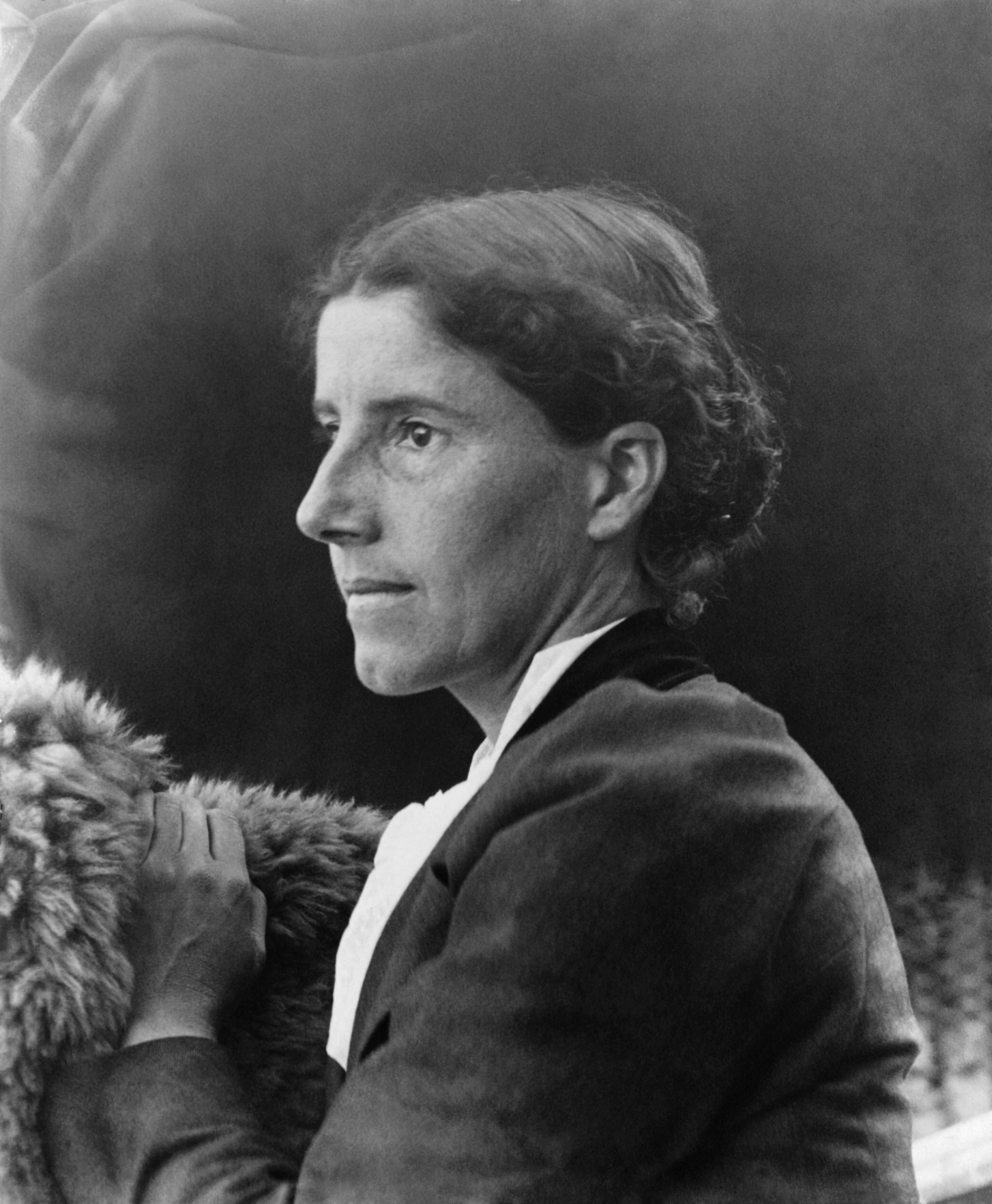
https://upload.wikimedia.org/wikipedia/commons/0/00/Charlotte_Perkins_Gilman_c._1900.jpg

Charlotte Perkins Gilman (1860 – 1935), also known as Charlotte Perkins Stetson, her first married name, was a prominent American humanist, novelist, writer of short stories, poetry and nonfiction, and a lecturer for social reform. She was a utopian feminist and served as a role model for future generations of feminists because of her unorthodox concepts and lifestyle. She has been inducted into the National Women's Hall of Fame. Her best remembered work today is her semi-autobiographical short story "The Yellow Wallpaper", which she wrote after a severe bout of postpartum psychosis. 

4610040_Bez_nazvaniya (580x40, 29Kb)