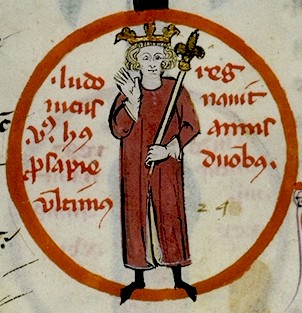
Louis V (c. 966 or 967 – 21 May 987),
also known as Louis the Do-Nothing (Louis le Fainéant)
CHAPTER I
THE FOUNTAIN OF THE HINDS
A spring of living
water, known in the neighborhood by the appropriate name of the
"Fountain of the Hinds," empties its trickling stream under the oaks of
one of the most secret recesses of the forest of Compiegne. Stags and
hinds, deers and does, bucks and she-goats come to water at the spot,
leaving behind them numerous imprints of their steps on the borders of
the rill, or on the sandy soil of the narrow paths that these wild
animals have worn across the copse.
One early morning in
the year 987, the sun being up barely an hour, a woman, plainly dressed
and breathing hard with rapid walking, stepped out of one of these
paths and stopped at the Fountain of the Hinds. She looked in all
directions in surprise as if she expected to have been preceded by some
one at the solitary rendezvous. Finding her hopes deceived, she made an
impatient motion, sat down, still out of breath, on a rock near the
fountain, and threw off her cape.
The woman, barely
twenty years of age, had black hair, eyes and eye-brows; her complexion
was brown; and cherry-red her lips. Her features were handsome, while
the mobility of her inflated nostrils and the quickness of her motions
betokened a violent nature. She had rested only a little while when she
rose again and walked up and down with hurried steps, stopping every now
and then to listen for approaching footsteps. Catching at last the
sounds of a distant footfall, she thrilled with joy and ran to the
encounter of him she had been expecting. He appeared. It was a man, also
in plain garb and in the vigor of age, large-sized and robust, with a
piercing eye and somber, wily countenance. The young woman leaped at a
bound into the arms of this personage, and passionately addressed him:
"Hugh, I meant to overwhelm you with reproaches; I meant to strike you;
but here you are and I forget everything," and in a transport of amorous
delight she added, suiting the deed to the words: "Your lips! Oh, give
me your lips to kiss!"
After the exchange
of a shower of kisses, and disengaging himself, not without some effort,
from the embrace of the fascinated woman, Hugh said to her gravely: "We
cannot indulge in love at this hour."
"At this hour, today, yesterday, tomorrow, everywhere and always, I love and shall continue to love you."
"Blanche, they are
foolhardy people who use the word 'always,' when barely fourteen years
separate us from the term assigned for the end of the world! This is a
grave and a fearful matter!"
"What! Can you have
given me this early morning appointment at this secreted place, whither I
have come under pretext of visiting the hermitage of St. Eusebius, to
talk to me about the end of the world ? Hugh ... Hugh.... To me there is
no end of the world but when your love ends!"
"Trifle not with
sacred matters! Do you not know that in fourteen years, the first day of
the year 1000, this world will cease to be and with it the people who
inhabit it ?"
Struck by the
coldness of her lover's answers, Blanche brusquely stepped back. Her
brows contracted, her nostrils dilated, her breast heaved in pain, and
she darted a look at Hugh that seemed to wish to fathom the very bottom
of his heart. For a few instants her gaze remained fixed upon him; she
then cried in a voice trembling with rage: "You love some other woman !
You love me no more !"
"Your words are senseless !"
"Heaven and earth !
Am I also to be despised.... I the Queen!... Yes, you love some other
woman, your own wife, perhaps; that Adelaide of Poitiers whom you
promised me you would rid yourself of by a divorce !" Further utterances
having expired upon her lips, the wife of King Louis the Do-nothing
broke down sobbing, and with eyes that glistened with fury she shook her
fists at the Count of Paris: "Hugh, if I were sure of that, I would
kill both you and your wife; I would stab you both to death!"
"Blanche," said Hugh
slowly and watching the effect of his words upon the face of the Queen,
who, with eyes fixed upon the ground, seemed to be meditating some
sinister project: "I am not merely Count of Paris and Duke of France, as
my ancestors were, I am also Abbot of Saint Martin of Tours and of
Saint-Germain-des-Pres, abbot not only by virtue of my cowl—but by
virtue of my faith. Accordingly, I blame your incredulity on the subject
of the approaching end of the world. The holiest bishops have
prophesied it, and have urged the faithful to hasten to save their souls
during the fourteen years that still separate them from the last
judgment.... Fourteen years!... A very short period within which to gain
the eternal paradise!"
"By the hell that
burns in my heart, the man is delivering a sermon to me!" cried the
Queen with an outburst of caustic laughter. "What are you driving at?
Are you spreading a snare for me? Malediction! this man is a compound of
ruse, artifice and darkness, and yet I love him! I am insane!... Oh,
there must be some magic charm in this!" and biting into her
handkerchief with suppressed rage, she said to him: "I shall not
interrupt again, even if I should choke with anger. Proceed, Hugh the
Capet! Explain yourself!"
"Blanche, the
approach of the dreadful day when the world is to end makes me uneasy
about my salvation. I look with fright at our double adultery, seeing we
are both married." Stopping with a gesture a fresh explosion of rage on
the part of the Queen, the Count of Paris added solemnly raising his
hand heavenward: "I swear to God by the salvation of my soul, were you a
widow, I would obtain a divorce from the Pope, and I would marry you
with holy joy. But likewise do I swear to God by the salvation of my
soul, I wish no longer to brave eternal punishment by continuing a
criminal intercourse with a woman bound, as I am myself, by the
sacrament of marriage. I wish to spend in the mortification of the
flesh, in fasting, abstinence, repentance and prayer the years that
still separate us from the year 1000, to the end that I may obtain from
our Lord God the remission of my sins and of my adultery with you.
Blanche, seek not to alter my decision. According as the caprice of your
love led you, you have alternately boasted over and cursed the
inflexibility of my character. Now, what I have said is said. This shall
be the last day of our adulterous intercourse. Our carnal relations
shall then end."
While Hugh the Capet
was speaking, the wife of Louis the Do-nothing contemplated his face
with devouring attention. When he finished, so far from breathing forth
desperate criminations, she carried both her hands to her forehead and
seemed steeped in mediation. Looking askance upon Blanche, the Count of
Paris anxiously waited for the first word from the Queen. Finally, a
tremor shook her frame, she raised her head, as if struck by a sudden
thought, and curbing her emotions she asked: "Do you believe that King
Lothaire, the father of my husband Louis, died of poison in March of
last year?"
"I believe he was poisoned."
"Do you believe that Imma, his wife, was guilty of poisoning her husband?"
"She is accused of the crime."
"Do you believe Imma guilty of the crime?"
"I believe what I see."
"And when you do not see?"
"Doubt is then natural."
"Do you know that in that murder Queen Imma's accomplice was her lover Adalberon, bishop of Laon?"
"It was a great scandal to the church!"
"After the poisoning
of Lothaire, the Queen and the bishop, finally delivered from the eyes
of her husband, indulged their love more freely."
"A double and horrible sacrilege!" cried the Count of Paris with indignation. "A bishop and a Queen adulterers and homicides!"
Blanche seemed
astonished at the indignation of Hugh the Capet and again contemplated
him attentively. She then proceeded with her interrogatory:
"Are you aware,
Count of Paris, that King Lothaire's death is a happy circumstance for
you—provided you were ambitious? Bishop Adalberon, the accomplice and
lover of the Queen, that bishop, expert in poisons, was your friend!"
"He was my friend before his crime."
"You repudiate his friendship, but you profit by his crime. That is high statecraft."
"In what way,
Blanche, have I profited by that odious crime? Does not the son of
Lothaire reign to-day? When my ancestors, the Counts of Paris, aspired
at the crown they did not assassinate the kings, they dethroned them.
Thus Eudes dethroned Charles the Fat, and Rothbert, Charles the Simple. A
transmission of crowns is easy."
"All of which did
not prevent Charles the Simple, the nephew of Charles the Fat from
re-ascending the throne, the same as Louis Outer-mer, the son of Charles
the Simple, also resumed his crown. On the other hand, King Lothaire,
who was poisoned last year, will never reign again. Whence we see, it is
better to kill the kings than to dethrone them ... if one wishes to
reign in their stead. Not so, Count of Paris?"
"Yes, provided one does not care for the excommunications of the bishops, nor for the eternal flames."
"Hugh, if perchance my husband, although young, should die?... That might happen."
"The will of the
Lord is all-powerful," answered Hugh with a contrite air. "There be
those who to-day are full of life and youth, and to-morrow are corpses
and dust! The designs of God are impenetrable."
"So that if
perchance the King, my husband, should die," rejoined Blanche, without
taking her eyes from the face of the Count of Paris, "in short, if some
day or other I become a widow—your scruples will then cease ... my love
will no longer be adulterous, would it, Hugh?"
"No, you would then be free."
"And will you remain
faithful to what you have just said ... 'Blanche, I swear to God by the
salvation of my soul, if you should become a widow I shall separate
from my wife Adelaide of Poitiers, and I shall marry you with a pure and
holy joy.' ... Will you be faithful to that oath?"
"Blanche, I repeat
it," answered Hugh the Capet avoiding the Queen's eyes that remained
obstinately fixed upon him. "I swear to God by the salvation of my soul,
if you become a widow I shall demand of the Pope permission to divorce
Adelaide of Poitiers, and I shall marry you. Our love will then have
ceased to be criminal."
An interval of silence again followed the words of the Count of Paris, whereupon Blanche resumed slowly:
"Hugh, there are strange and sudden deaths."
"Indeed, strange and sudden deaths have been seen in royal families."
"None is safe from accident. Neither princes nor subjects."
"Only the will of heaven disposes of our fates. We must bow before the decrees of God."
"My husband, Louis, the Do-nothing, is, like all other people, subject to death and the decrees of Providence."
"Indeed, kings as well as subjects."
"It may then happen,
although he is now barely twenty, that he die suddenly ... within a
year ... within six months ... to-morrow ... to-day...."
"Man's end is death."
"Should that
misfortune arrive," the Queen proceeded after a pause, "there is one
thing that alarms me, Hugh, and on which I desire your advice."
"What, my dear Blanche?"
"Calumniators, seeing Louis dies so suddenly, might talk ... about poison."
"A pure conscience despises calumny. The wicked may be disregarded."
"Oh, as to me, I
would despise them. But, you, Hugh, my beloved, whatever may be said,
would you also accuse me of being a poisoner? Would you pass such a
judgment upon me?"
"I believe what I
see.... If I do not see, I doubt. Blanche, may the curse of heaven fall
upon me if I ever could be infamous enough to conceive such a suspicion
against you!" cried Hugh the Capet taking the Queen in his arms with
passionate tenderness. "What! If the Lord should call your husband to
Him He would fulfil the most cherished dreams of my life! He would allow
me to sanctify with marriage the ardent love that I would sacrifice
everything to, everything except my eternal salvation! And would I,
instead of thanking God, suspect you of an odious crime! You the soul of
my life!"
The Queen seemed
overwhelmed with ecstacy. Hugh the Capet proceeded in a low and
tremulous voice: "Oh, joy of my heart, if some day you should be my wife
before God, our souls would then merge in one and in a love that would
then be pure and holy. Then, Oh joy of Heaven, we shall not age! The end
of the world approaches. Together we shall quit life full of ardor and
love!" saying which the Count of Paris drew his mouth close to the lips
of the Queen. The latter closed her eyes and muttered a few words in a
faint voice. Hugh the Capet, however, suddenly and with great effort
disengaged himself from Blanche's arms exclaiming: "A superhuman courage
is needed to overcome the passion that consumes me! Adieu, Blanche,
well-beloved of my heart, I return to Paris!"
With these words
Hugh the Capet disappeared in the copse, while the Queen, overpowered
with passion and the struggle within herself, followed him with her
eyes: "Hugh, my lover, I shall be a widow, and you King!"
CHAPTER II
THE IDIOT
Among the household
serfs of the royal domain of Compiegne was a young lad of eighteen named
Yvon. Since the death of his father, a forester serf, he lived with his
grandmother, the washerwoman for the castle, who had received
permission from the bailiff to keep her grandson near her. Yvon was at
first employed in the stables; but having long lived in the woods, he
looked so wild and stupid that he was presently taken for an idiot, went
by the name of Yvon the Calf, and became the butt of all. The King
himself, Louis the Do-nothing, amused himself occasionally with the
foolish pranks of the young serf. He was taught to mimic dogs by barking
and walking on all fours; he was made to eat lizards, spiders and
grass-hoppers for general amusement. Yvon always obeyed with an idiotic
leer. Thus delivered to the sport and contempt of all, since his
grandmother's death, the lad met at the castle with the sympathy of none
except a poor female serf named Marceline the Golden-haired from the
abundant gold-blonde ornament of her head. The young girl was a helper
of Adelaide, the favorite lady of the Queen's chamber.
The morning of the
day that Blanche and Hugh the Capet had met at the Fountain of the
Hinds, Marceline, carrying on her head a bucket of water, was crossing
one of the yards of the castle towards the room of her mistress.
Suddenly she heard a volley of hisses, and immediately after she saw
Yvon enter the yard pursued by several serfs and children of the domain,
crying at the top of their voices: "The Calf!" "The Calf!" and throwing
stones and offal at the idiot. Marceline revealed the goodness of her
heart by interesting herself in the wretch, not that Yvon's features or
limbs were deformed, but that the idiotic expression of his face
affected her. He was in the habit of dressing his long black hair in
five or six plaids interwoven with wisps of straw, and the coiffure fell
upon his neck like as many tails. Barely clad in a sorry hose that was
patched with materials of different colors, his shoes were of rabbit or
squirrel skin fastened with osiers to his feet and legs. Closely pursued
from various sides by the serfs of the castle, Yvon made several
doublings in the yard in order to escape his tormentors, but perceiving
Marceline, who, standing upon the first step of the turret stairs that
she was about to ascend, contemplated the idiot with pity, he ran
towards the young girl, and throwing himself at her feet said joining
his hands: "Pardon me, Marceline, but protect poor Yvon against these
wicked people!"
"Climb the stairs
quick!" Marceline said to the idiot, pointing up the turret. Yvon rose
and swiftly followed the advice of the serf maid, who, placing herself
at the door, lay down her bucket of water, and addressing Yvon's
tormentors, who were drawing near, said to them: "Have pity for the poor
idiot, he harms no one."
"I have just seen
him leap like a wolf out of the copse of the forest from the side of the
Fountain of the Hinds," cried a forester serf. "His hair and the rags
he has on are wet with dew. He must have been in some thicket spreading
nets for game which he eats raw."
"Oh, he is a worthy
son of Leduecq, the forester, who lived like a savage in his den, never
coming out of the woods!" observed another serf. "We must have some fun
with the Calf."
"Yes, yes, let us
dip him up to his ears in the neighboring pool in punishment for
spreading nets to catch game with," said the forester; and taking a step
toward Marceline who remained at the door: "Get out of the way, you
servant of the devil, or we shall give you a ducking along with the
Calf!"
"My mistress, Dame
Adelaide, a lady of the Queen's chamber, will know how to punish you if
you ill-treat me. Begone, you heartless people!"
"The devil take Adelaide! To the pool with the Calf!"
"Yes, to the pool with him! And Marceline also! A good mud-bath for both!"
At the height of the
tumult, one of the casements of the castle was thrown open, and a young
man of twenty years at most leaned out and cried angrily: "I shall have
your backs flayed with a sound strapping, you accursed barking dogs!"
"The King!" exclaimed the tormentors of Yvon, and a minute later all had fled by the gate of the yard.
"Halloa, you girl!"
called out Louis the Do-nothing to Marceline who was taking up her
bucket of water. "What was the cause of the infernal racket made by that
noisy pack?"
"Seigneur," answered Marceline trembling, "they wanted to ill-treat poor Yvon."
"Is the Calf about?"
"Seigneur, I know
not where he is gone to hide," explained the maid who feared lest Yvon,
barely escaped from one set of tormentors, should fall into the hands of
the whimsical King. As the latter thereupon withdrew from the window,
Marceline hastened to ascend the stair of the turret. She had scarcely
mounted a dozen steps when she saw Yvon crouching with his elbows on his
knees and his chin in his hands. At the sight of the maid he shook his
head and with a voice full of emotion said: "Good you; oh, you good!
Marceline good!" and he fixed his eyes so full of gratitude upon her
that she observed aloud with a sigh: "Who would believe that this
wretch, with eyes at times so captivating, still is deprived of reason?"
and again laying down her bucket she said to the idiot: "Yvon, why did
you go this morning into the forest? Your hair and rags are really moist
with dew. Is it true that you spread nets to take game?" The idiot
answered with a stupid smile, swaying his head backward and forward.
"Yvon," said Marceline, "do you understand me?" The idiot remained mute,
but presently observing the bucket of water that the maid had laid down
at his feet, he lifted it up, placed it on his own head, and motioned
to Marceline to go up ahead of him. "The poor creature is expressing his
gratitude as well as he can," Marceline was thinking to herself when
she heard steps above coming down the stairs, and a voice cried out:
"Oh, Calf, is it you?"
"That is the voice
of one of the King's servants," said Marceline. "He is coming for you,
Yvon. Oh, you are going to fall into another tormentor's hands!"
Indeed, one of the
men of the royal chamber appeared at the turning of the winding stairs
and said to the idiot: "Come, get up quick and follow me! Our lord the
King wishes to amuse himself with you, you double Calf!"
"The King! Oh! Oh!
The King!" cried Yvon with a triumphant air, clapping his hands gayly.
The bucket being left unsupported on his head, fell and broke open at
the feet of the King's servitor whose legs were thereby drenched up to
his knees.
"A plague upon the
idiot!" cried Marceline despite all her good-heartedness. "There is the
bucket broken! My mistress will beat me!"
Furious at the
accident that drenched his clothes, the royal servitor hurled
imprecations and insults upon Yvon the Calf, who, however, seeming not
to notice either the imprecations or the insults, continued to repeat
triumphantly: "The King! Oh! Oh! The King!"
CHAPTER III
LOUIS THE DO-NOTHING
Like his wife Louis
the Do-nothing was barely twenty years of age. Justly nicknamed the
"Do-nothing," he looked as nonchalant as he seemed bored. After having
scolded through the window at the serfs, whose noise annoyed him, he
stretched himself out again upon his lounge. Several of his familiar
attendants stood around him. Yawning fit to dislocate his jaws, he said
to them: "What a notion that was of the Queen's to go at sunrise with
only one lady of the chamber to pray at the hermitage of St. Eusebius!
Once awakened, I could not fall asleep again. So I rose! Oh, this day
will be endless!"
"Seigneur King, would you like to hunt?" suggested one of the attendants. "The day is fine. We would certainly kill some game."
"The hunt fatigues me. It is a rude sport."
"Seigneur King, would you prefer fishing?"
"Fishing tires me; it is a stupid pastime."
"Seigneur King, if you call your flute and lute-players, you might enjoy a dance."
"Music racks my head, and I cannot bear dancing. Let's try something else."
"Seigneur King, shall your chaplain read to you out of some fine work?"
"I hate reading. I think I could amuse myself with the idiot. Where is he?"
"Seigneur King, one of your attendants has gone out to find him.... I hear steps.... It is surely he coming."
The door opened and a
servitor bent the knee and let in Yvon. From the moment of his entrance
Yvon started to walk on all fours, barking like a dog; after a little
while he grew livelier, jumped and cavorted about clapping his hands and
shouting with such grotesque contortions that the King and the
attendants began to laugh merrily. Encouraged by these signs of
approbation and ever cavorting about, Yvon mimicked alternately the
crowing of a rooster, the mewing of a cat, the grunting of a hog and the
braying of an ass, interspersing his sounds with clownish gestures and
ridiculous leaps, that redoubled the hilarity of the King and his
courtiers. The merriment was at its height when the door was again
thrown open, and one of the chamberlains announced in a loud voice from
the threshold where he remained: "Seigneur King, the Queen approaches!"
At these words the attendants of Louis, some of whom had dropped upon
stools convulsing with laughter, rose hastily and crowded to the door to
salute the Queen at her entrance. Louis, however, who lay stretched on
his lounge, continued laughing and cried out to the idiot: "Keep on
dancing, Calf! Dance on! You are worth your weight in gold! I never
amused myself better!"
"Seigneur King, here
is the Queen!" said one of the courtiers, seeing Blanche cross the
contiguous chamber and approach the door. The wing of this door, when
thrown open almost reached the corner of a large table that was covered
with a splendid Oriental piece of tapestry, the folds of which reached
to the floor. Yvon the Calf continued his gambols, slowly approaching
the table, and concealed from the eyes of the King by the head-piece of
the lounge on which the latter remained stretched. Ranged at the
entrance of the door in order to salute the Queen, the prince's
attendants had their backs turned to the table under which Yvon quickly
blotted himself out at the moment when the seigneurs were bowing low
before Blanche. The Queen answered their salute, and preceding them by a
few steps moved towards Louis, who had not yet ceased laughing and
crying out: "Ho, Calf, where are you? Come over this way that I may see
your capers.... Have you suddenly turned mute, you who can bark, mew and
crow so well?"
"My beloved Louis is
quite merry this morning," observed Blanche caressingly and approaching
her husband's lounge. "Whence proceeds the mirth of my dear husband?"
"That idiot could
make a dead man laugh with his capers. Ho, there, Calf! Come this way,
you scamp, or I'll have your bones broken!"
"Seigneur King,"
said one of the attendants after glancing around the room for Yvon, "the
Calf must have escaped at the moment when the door was opened to admit
the Queen. He is not here, nor in the adjoining room."
"Fetch him back, he can not be far!" cried the King impatiently and with rising anger. "Bring him back here immediately!"
One of the seigneurs
hurried out to execute the King's orders, while Blanche letting herself
down near him, said, smiling tenderly: "I shall try, my beloved
seigneur, to enable you to wait patiently for the idiot's return."
"Fetch him back. All of you run after him; the more of you look after him, the quicker will he be found."
Bowing to the King's orders, the courtiers trooped out of the apartment in search of Yvon.
CHAPTER IV
A ROYAL COUPLE
Blanche remained
alone with her husband, whose face, that for a moment had brightened up,
speedily resumed its normal expression of lassitude. The Queen had
thrown off her simple vestment of the morning to don a more elaborate
costume. Her black hair, braided with pearls, was combed with skill. She
wore an orange colored robe of rich material, with wide flowing
sleeves, leaving half exposed her breast and shoulders. A collar and
gold bracelets studded with precious stones ornamented her neck and
arms. Still reclining on his lounge, now shared by his wife who sat down
at its edge, Louis did not even bestow a glance upon her. With his head
leaning upon one of the pillows, he was mumbling: "You will see the
clumsy fellows will turn out more stupid than the idiot; they will not
catch him."
"In such a
disastrous event," replied Blanche with an insinuating smile, "I shall
have to console you, my darling. Why is your face so careworn? Will you
not deign as much as to throw your eyes upon your wife, your humble
servant?"
Louis indolently turned his head towards his wife and said: "How dressed up you are!"
"Does this dress
please my amiable master?" inquired the Queen caressingly; but noticing
that the King suddenly shivered, became gloomy and brusquely turned away
his head, she added: "What is the matter, Louis?"
"I do not like the color of that dress!"
"I am sorry I did not know the color of orange displeased you, dear seigneur. I would have guarded against putting it on."
"You were dressed in the same color on the first day of this month last year."
"My memory is not as perfect as yours on the subject, my dear seigneur."
"It was on the second of May of last year that I saw my father die, poisoned by my mother!" answered the King mournfully.
"What a sad souvenir! How I now hate this accursed orange color, seeing it awakens such recollections in your mind!"
The King remained
silent; he turned on his cushions and placed his hands over his eyes.
The door of the apartment was re-opened and one of the courtiers said:
"Seigneur, despite all our search, we have not been able to find Yvon
the Calf; he must have hidden in some corner; he shall be severely
punished soon as we find him again." Louis made no answer, and Blanche
motioned the courtier with an imperious gesture to retire. Left again
alone, and seeing her husband more and more mentally troubled, Blanche
redoubled her blandishments, seeking to provoke a return of her
caresses: "Dear seigneur, your sadness afflicts me."
"Your tenderness is extreme ... this morning. Quite different from usual."
"My tenderness for you increases by reason of the sorrow that I see you steeped in, dear seigneur."
"Oh, I lost everything with my father's death," Louis murmured despondently, and he added with concentrated fury:
"That felonious
bishop of Laon! Poisoner and adulterer! Infamous prelate! And my mother!
my mother his accomplice! Such crimes portend the end of the world! I
shall punish the guilty!"
"Pray, my seigneur, do forget that dark past. What is it you said about the end of the world? It is a fable."
"A fable! What! Do not the holiest bishops assert that in fourteen years the world must come to an end ... in the year 1000?"
"What makes me
question their assertion, Louis, is that, while announcing the end of
the world, these prelates recommend to the faithful to part with their
goods to the Church and to donate their domains to them."
"Of what use would it be to keep perishable riches if soon everything is to perish?"
"But then, dear
seigneur, if everything is to perish, what is the Church to do with the
goods that she is eternally demanding from the faithful?"
"After all, you are
right. It may be another imposture of the tonsured fraternity. Nor
should anything of the sort surprise us when we see bishops guilty of
adultery and poisoning."
"You always come
back to those lugubrious thoughts, dear seigneur! Pray forget those
unworthy calumnies regarding your mother.... Just God! Can a woman be
guilty of her husband's murder! Impossible! God would not permit it!"
"But did I not
witness the agony and death of my father! Oh, the effect of the poison
was strange ... terrible!" said the King in somber meditation. "My
father felt his feet growing cold, icy and numb, unable to support him.
By degrees the mortal lethargy invaded his other members, as if he were
being slowly dipped into an ice bath! What a terrible spectacle that
was!"
"There are illnesses
so sudden, so strange, my beloved master.... When such crimes are
charged, I am of those who say: 'When I see I believe, when I do not see
I refuse to accept such theories.'"
"Oh, I saw but too
much!" cried Louis, and again hiding his face in his hands he added in a
distressful voice: "I know not why these thoughts should plague me
to-day. Oh, God, have pity on me. Remove these fears from my spirit!"
"Louis, do not weep
like that, you tear my heart to pieces. Your sadness is a wrong done to
this beautiful May day. Look out of the window at that brilliant sun;
look at the spring verdure of the forest; listen to the gay twittering
of the birds. Why, all around us, everything in nature is lovely and
joyous; you alone are sad! Come, now, my beautiful seigneur," added
Blanche taking both the hands of the King. "I am going to draw you out
of this dejection that distresses me as much as it does you.... I am all
the gladder at my project, which is intended to please and amuse you."
"What is your project?"
"I propose to spend
the whole day near you. We shall take our morning meal here. I have
issued orders to that effect, my indolent boy. After that we shall go to
mass. We shall then take a long outing in a litter through the forest.
Finally.... But, no, no, the surprise I have in store for you shall
remain a secret. It shall be the price of your submission."
"What is the surprise about?"
"You will never have
spent such a delightful evening.... You whom everything tires and whom
everything is indifferent to ... you will be charmed by what I have in
store for you, my dear husband."
Louis the
Do-nothing, a youth of indolent and puerile mind, felt his curiosity
pricked, but failed to draw any explanation from Blanche. A few minutes
later the chamberlains and servants entered carrying silver dishes and
gold goblets, together with the eatables that were to serve for the
morning repast. Other attendants of the royal chamber took up the large
table covered to the floor with tapestry and under which Yvon the Calf
had hidden himself, and carried it forward to the lounge on which were
Louis and Blanche. Bent under the table, and completely concealed by the
ample folds of the cover which trailed along the floor, the idiot moved
forward on his hands and knees as, carried by the servants, the table
was being taken towards the royal lounge. When it was set down before
Louis and Blanche, Yvon also stopped. Menials and equerries were
preparing to render the habitual services at table when the Queen said
smiling to her husband: "Will my charming master consent that to-day I
be his only servant?"
"If it please you,"
answered Louis the Do-nothing, and he proceeded in an undertone: "But
you know that according to my habit I shall neither eat nor drink
anything that you have not tasted before me."
"What a child you
are!" answered Blanche smiling upon her husband with amiable reproach.
"Always suspicious! We shall drink from the same cup like two lovers."
The officers of the King left upon a sign from the Queen. She remained alone with Louis.
CHAPTER V
THE FOUNDING OF A DYNASTY
Day was waning.
Darkness began to invade the spacious apartment where seventy-five years
before Francon, archbishop of Rouen, informed Charles the Simple that
he was to give his daughter Ghisele together with the domains of
Neustria to Rolf the Norman pirate, and where now King Louis and his
wife Blanche had spent the day.
Louis the Do-nothing
was asleep at full length upon his lounge near to the table that was
still covered with the dishes and vases of gold and silver. The King's
sleep was painful and restless. A cold sweat ran down his forehead that
waxed livid by the second. Presently an overpowering torpor succeeded
his restlessness, and Louis remained plunged in apparent calmness,
although his features were rapidly becoming cadaverous. Standing behind
the lounge with his elbows resting against its head, Yvon the Calf
contemplated the King of the Franks with an expression of somber and
savage triumph. Yvon had dropped his mask of stupidity. His features now
revealed undisguised intelligence, hidden until then by the semblance
of idiocy. The profoundest silence reigned in the apartment now darkened
by the approach of night. Suddenly, emitting a deep groan, the King
awoke with a start. Yvon stooped down and disappeared behind the lounge
while the King muttered to himself: "There is a strange feeling upon
me.... I felt so violent a pain in my heart that it woke me up...." then
looking towards the window: "What! Is it night!... I must have slept
long.... Where is the Queen?... Why was I left alone?... I feel heavy
and my feet are cold.... Halloa, someone!" he called out turning his
face to the door, "Halloa, Gondulf!... Wilfrid!... Sigefried!" At the
third name that he pronounced, Louis' voice, at first loud, became
almost unintelligible, it sunk to a husky whisper. He sat up. "What is
the matter with me? My voice is so feeble that I can hardly hear myself.
My throat seems to close ... then this icy feeling ... this cold that
freezes my feet and is rising to my legs!" The King of the Franks had
barely uttered these words when a shudder of fear ran through him. He
saw before him Yvon the Calf who had suddenly risen and now stood erect
behind the head of the lounge. "What are you doing there?" asked Louis,
and he immediately added with a sinking voice: "Run quick for some
one.... I am in danger....", but interrupting himself he observed: "Of
what use is such an order; the wretch is an idiot.... Why am I left thus
alone?... I shall rouse myself," and Louis rose painfully; but hardly
had he put his feet down when his limbs gave way under him and he fell
in a heap with a dull thud upon the floor. "Help! Help!... Oh, God, have
pity upon me!... Help!"
"Louis, it is too
late!" came from Yvon in a solemn voice. "You are about to die ...
barely twenty years old, Oh, King of the Franks!"
"What says that idiot? What is the Calf doing here?"
"You are about to die as died last year your father Lothaire, poisoned by his wife! You have been poisoned by Queen Blanche!"
Fear drew a long cry
from Louis; his hair stood on end over his icy forehead, his lips, now
purple, moved convulsively without producing a sound; his eyes, fixed
upon Yvon, became troubled and glassy, but still retaining a last
glimmer of intelligence, while the rest of his body remained inert.
"This morning," said
Yvon, "the Count of Paris, Hugh the Capet, met your wife by appointment
in the forest. Hugh is a cunning and unscrupulous man. Last year he
caused the poisoning of your father by Queen Imma and her accomplice the
bishop of Laon; to-day he caused you to be poisoned by Blanche, your
wife, and to-morrow the Count of Paris will be King!" Louis understood
what Yvon was saying, although his mind was beclouded by the approach of
death. A smile of hatred contracted his lips. "You believed yourself
safe from danger," Yvon proceeded, "by compelling your wife to eat of
the dishes that she served you. All poison has its antidote. Blanche
could with impunity moisten her lips in the wine she had poisoned—"
Louis seemed hardly to hear these last words of Yvon; his limbs
stiffened, his head dropped and thumped against the floor; his eyes
rolled for a last time in their depths; a slight froth gathered on his
now blackened lips; he uttered a slight moan, and the last crowned scion
of the Carlovingian stock had passed away.
"Thus end the royal
races! Thus, sooner or later, do they expiate their original crime!"
thought Yvon contemplating the corpse of the last Carlovingian king
lying at his feet. "My ancestor Amæl, the descendant of Joel and of
Genevieve, declined to be the jailor of little Childeric, in whom the
stock of Clovis was extinguished, and now I witness the crime by which
is extinguished, in the person of Louis the Do-nothing, the stock of
Charles the Great—the second dynasty of the conquerers of Gaul.
Perchance some descendant of my own will in the ages to come witness the
punishment of this third dynasty of kings, now raised by Hugh the Capet
through an act of cowardly perfidy!"
Steps were heard
outside. Sigefried, one of the courtiers, entered the apartment saying
to the King: "Seigneur, despite the express orders of the Queen, who
commanded us not to disturb your slumber, I come to announce to you the
arrival of the Count of Paris."
So saying, Sigefried
drew near, leaving the door open behind him. Yvon profited by the
circumstance and groped his way out of the apartment under cover of the
dark. Receiving no answer from Louis, Sigefried believed the King was
still asleep, when, drawing still nearer he saw the King's body lying on
the floor. He stooped and touched the icy hand. Struck with terror he
ran to the door crying out: "Help!... Help!" and crossed the next room
continuing to call for assistance. Several servitors soon appeared with
torches in their hands, preceding Hugh the Capet, who now was clad in
his brilliant armor and accompanied by several of his officers. "What?"
cried the Count of Paris addressing Sigefried in an accent of surprise
and alarm, "The King cannot be dead!"
"Oh, Sire, I found
Louis on the floor where he must have dropped down from the lounge. I
touched his hand. It was icy!" saying which Sigefried followed Hugh the
Capet into the apartment that now was brilliantly lighted by the torches
of the servants. The Count of Paris contemplated for an instant the
corpse of the last Carlovingian king, and cried in a tone of pity: "Oh!
Dead! And only twenty years of age!" and turning towards Sigefried with
his hands to his eyes as if seeking to conceal his tears: "How can we
account for so sudden a death?"
"Seigneur, the King
was in perfect health this morning. He sat down at table with the Queen;
after that she left giving us orders not to disturb her husband's
sleep; and—" Sigefried's report was interrupted by nearing lamentations,
and Blanche ran in followed by several of her women. Her hair was
tumbled, her looks distracted. "Is Louis really dead?" and upon the
answer that she received she cried:
"Woe is me! Woe is
me! I have lost my beloved husband! For pity's sake, seigneur Hugh, do
not leave me alone! Oh, promise me to join your efforts to mine to
discover the author of his death, if my Louis died by crime!"
"Oh, worthy spouse, I
swear to God and his saints, I shall help you discover the criminal!"
answered Hugh the Capet solemnly; and seeing Blanche tremble and stagger
on her feet like one about to fall he cried: "Help! Blanche is
swooning!" and he received in his arms the seemingly fainting body of
Blanche who whispered in his ear: "I am a widow ... you are King!"
CHAPTER VI
YVON AND MARCELINE
Upon leaving the
room where lay the corpse of Louis the Do-nothing, Yvon descended the
stairs to the apartment of Adelaide, the lady of the Queen's chamber,
and mistress of the golden-haired Marceline, whom he expected to find
alone, Adelaide having followed the Queen when the latter ran to the
King's apartment feigning despair at the death of her husband. Yvon
found the young female serf at the threshold of the door in a state of
great agitation at the tumult that had suddenly invaded the castle.
"Marceline," Yvon said to her, "I must speak with you; let us step into
your mistress's room. She will not leave the Queen for a long time. We
shall not be interrupted. Come!" The young woman opened wide her eyes at
seeing for the first time the Calf expressing himself in a sane manner,
and his face now free of its wonted look of stupidity. In her
astonishment, Marceline could not at first utter a word, and Yvon
explained, smiling: "Marceline, my language astonishes you. The reason
is, you see, I am no longer Yvon the Calf but ... Yvon who loves you!
Yvon who adores Marceline!"
"Yvon who loves me!" cried the poor serf in fear. "Oh, God, this is some sorcery!"
"If so, Marceline,
you are the sorceress. But, now, listen to me. When you will have heard
me, you will answer me whether you are willing or not to have me for
your husband." Yvon entered the room mechanically followed by Marceline.
She thought herself in a dream; her eyes did not leave the Calf and
found his face more and more comely. She remembered that, often struck
by the affectionateness and intelligence that beamed from Yvon's eyes,
she had asked herself how such looks could come from a young man who was
devoid of reason.
"Marceline," he proceeded, "in order to put an end to your surprise, I must first speak to you of my family."
"Oh, speak, Yvon, speak! I feel so happy to see you speak like a sane person, and such language!"
"Well, then, my
lovely Marceline, my great-grandfather, a skipper of Paris named Eidiol,
had a son and two daughters. One of these, Jeanike, kidnapped at an
early age from her parents, was sold for a serf to the superintendant of
this domain, and later she became the wet-nurse of the daughter of
Charles the Simple, whose descendant, Louis the Do-nothing, has just
died."
"Is the rumor really true? Is the King dead? So suddenly? It is strange!"
"Marceline, these
kings could not die too soon. Well, then, Jeanike, the daughter of my
great-grandfather had two children, Germain, a forester serf of this
domain, and Yvonne, a charming girl, whom Guyrion the Plunger, son of my
great-grandfather, took to wife. She went with him to Paris, where they
settled down and where he plied his father's trade of skipper. Guyrion
had from Yvonne a son named Leduecq ... and he was my father. My
grandfather Guyrion remained in Paris as skipper. A woman named Anne the
Sweet was assaulted by one of the officers of the Count of the city,
and her husband, Rustic the Gay, a friend of my father, killed the
officer. The soldiers ran to arms and the mariners rose at the call of
Rustic and Guyrion, but both of them were killed together with Anne in
the bloody fray that ensued. My grandfather being one of the leaders in
the revolt, the little he owned was confiscated. Reduced to misery, his
widow left Paris with her son and came to her brother Germain the
forester for shelter. He shared his hut with Yvonne and her son. Such is
the iniquity of the feudal law that those who dwell a year and a day
upon royal or seigniorial domain become its serfs. Such was the fate of
my grandfather's widow and her son Leduecq. She was put to work in the
fields, Leduecq following the occupation of his uncle succeeded him as
forester of the canton of the Fountain of the Hinds. Later he married a
serf whose mother was a washerwoman of the castle. I was born of that
marriage. My father, who was as gentle towards my mother and myself as
he was rude and intractable towards all others, never ceased thinking of
the death of my grandfather Guyrion, who was slaughtered by the
soldiers of the Count of Paris. He never left the forest except to carry
his tax of game to the castle. Of a somber and indominable character,
often switched for his insubordination towards the bailiff's agents, he
would have taken a cruel revenge for the ill-treatment that he was
subjected to were it not for the fear of leaving my mother and myself in
want. She died about a year ago. My father survived her only a few
months. When I lost him, I came by orders of the bailiff to live with my
maternal aunt, a washerwoman at the castle of Compiegne. You now know
my family."
"The good Martha!
When you first came here she always said to me: 'It is no wonder that my
grandson looks like a savage; he never left the forest.' But during the
last days of her life your grandmother often said to me with tears in
her eyes: 'The good God has willed it that Yvon be an idiot.' I thought
as she did, and therefore had great pity for you. And yet, how mistaken I
was. You speak like a clerk. While you were just now speaking, I said
to myself: 'Can it be?... Yvon the Calf, who talks that way? And he in
love?'"
"And are you pleased to see your error dispelled? Do you reciprocate my feelings?"
"I do not know,"
answered the young serf blushing. "I am so taken by surprise by all that
you have been telling me! I must have time to think."
"Marceline, will you
marry me, yes or no? You are an orphan; you depend upon your mistress; I
upon the bailiff; we are serfs of the same domain; can there be any
reason why they should refuse their consent to our marriage?" And he
added bitterly: "Does not the lambkin that is born increase its master's
herd?"
"Alack! According to
the laws our children are born and die serfs as ourselves! But would my
mistress Adelaide give her consent to my marrying an idiot?"
"This is my project: Adelaide is a favorite and confidante of the Queen. Now, then this is a beautiful day for the Queen."
"What! The day when the King, her husband, died?"
"For that very
reason. The Queen is to-day in high feather, and for a thousand reasons
her confidante, your mistress, must feel no less happy than the widow of
Louis the Do-nothing. To ask for a favor at such a moment is to have it
granted."
"What favor would you ask?"
"If you consent to
marry me, Marceline, you will need Adelaide's permission and we shall
want her promise to have me appointed forester serf with the canton of
the Fountain of the Hinds under my charge. Two words of your mistress to
the Queen, two words of the Queen to the bailiff of the domain, and our
wishes are fulfilled."
"But, Yvon, do you
consider that everybody takes you for an idiot? And would they entrust
you with a canton? It is out of the question."
"Let them give me a bow and arrows and I am ready to acquit myself as an archer. I have an accurate eye and steady hand."
"But how will you
explain the sudden change that has turned you from an idiot to a sane
man? People will want to know why you pretended to be an idiot. You will
be severely punished for the ruse. Oh, my friend, all that makes me
tremble."
"After I am married I
shall tell you my reasons for my long comedy. As to my transformation
from idiocy to sanity, that is to be the subject of a miracle. The
thought struck me this morning while I followed your mistress and the
Queen to the hermitage of St. Eusebius. Everything is explainable with
the intervention of a saint."
"And why did you follow the Queen?"
"Having woke up this
morning before dawn, I happened near the fosse of the castle. Hardly
was the sun up when I saw at a distance your mistress and the Queen
going all alone towards the forest. The mysterious promenade pricked my
curiosity. I followed them at a distance across the copse. They arrived
at the hermitage of St. Eusebius. Your mistress remained there, but the
Queen took the path to the Fountain of the Hinds."
"What could she be up to at that early hour? My curiosity also is now pricked."
"That is another
question that I shall satisfy you upon after we are married, Marceline,"
answered Yvon after a moment's reflection; "but to return to the
miracle that is to explain my transformation from idiocy to sanity, it
is quite simple: St. Eusebius, the patron of the hermitage, will be
credited with having performed the prodigy, and the monk, who now
derives a goodly revenue from the hermitage will not deny my
explanation, seeing that the report of the new miracle will double his
tithes. His whole fraternity speculate upon human stupidity."
The golden-haired Marceline smiled broadly at the young man's idea, and replied:
"Can it be Yvon the Calf that reasons thus?"
"No, my dear and
sweet maid, it is Yvon the lover; Yvon on whom you took pity when he was
everybody else's butt and victim; Yvon, who, in return for your good
heart, offers you love and devotion. That is all a poor serf can
promise, seeing that his labor and his life belong to his master. Accept
my offer, Marceline, we shall be as happy as one can be in these
accursed times. We shall cultivate the field that surrounds the
forester's hut; I shall kill for the castle the game wanted there, and
as sure as the good God has created the stags for the hunt, we never
shall want for a loin of venison. You will take charge of our vegetable
garden. The streamlet of the Fountain of the Hinds flows but a hundred
paces from our home. We shall live alone in the thick of the woods
without other companions than the birds and our children. And now,
again, is it 'yes' or 'no'? I want a quick answer."
"Oh, Yvon," answered
Marceline, tears of joy running from her eyes, "if a serf could dispose
of herself, I would say 'yes' ... aye, a hundred times, 'yes'!"
"My beloved, our
happiness depends upon you. If you have the courage to request your
mistress's permission to take me for your husband, you may be certain of
her consent."
"Shall I ask Dame Adelaide this evening?"
"No, but to-morrow
morning, after I shall have come back with my sanity. I am going on the
spot to fetch it at the hermitage of St. Eusebius, and to-morrow I shall
bring it to you nice and fresh from the holy place—and with the monk's
consent, too."
"And people called
him the 'Calf'!" murmured the young serf more and more charmed at the
retorts of Yvon, who disappeared speedily, fearing he might be surprised
by the Queen's lady of the chamber, Adelaide.
CHAPTER VII
THE STOCK OF JOEL
Yvon's calculations
proved right. He had told Marceline that no more opportune time could be
chosen to obtain a favor from the Queen, so happy was she at the death
of Louis the Do-nothing and the expectation of marrying Hugh the Capet.
Thanks to the good-will of Adelaide, who consented to the marriage of
her maid, the bailiff of the domain also granted his consent to Yvon
after the latter, agreeable to the promise he had made Marceline,
returned with his sanity from the chapel of the hermitage of St.
Eusebius. The serf's story was, that entering the chapel in the evening,
he saw by the light of the lamp in the sanctuary a monstrous black
snake coiled around the feet of the saint; that suddenly enlightened by a
ray from on high, he stoned and killed the horrible dragon, which was
nothing else than a demon, seeing that no trace of the monster was left;
and that, in recompense for his timely assistance, St. Eusebius
miraculously returned his reason to him. In glorification of the miracle
that was thus performed by St. Eusebius in favor of the Calf, Yvon was
at his own request appointed forester serf over the canton of the
Fountain of the Hinds, and the very morning after his marriage to the
golden-haired Marceline, he settled down with her in one of the profound
solitudes of the forest of Compiegne, where they lived happily for many
years.
As was to be
expected, Marceline's curiosity, pricked on the double score of the
reasons that led Yvon to simulate idiocy for so many years, and that
took the Queen to the Fountain of the Hinds at the early hours of the
morning of May 2nd, instead of dying out, grew intenser. Yvon had
promised after marriage to satisfy her on both subjects. She was not
slow to remind him of the promise, nor he to satisfy her.
"My dear wife," said
Yvon to Marceline the first morning that they awoke in their new forest
home, "What were the motives of my pretended idiocy?—I was brought up
by my father in the hatred of kings. My grandfather Guyrion, slaughtered
in a popular uprising, had taught my father to read and write, so that
he might continue the chronicle of our family. He preserved the account
left by his grandfather Eidiol, the dean of the skippers of Paris,
together with an iron arrow-head, the emblem attached to the account. We
do not know whatever became of the branch of our family that lived in
Britanny near the sacred stones of Karnak. It has the previous
chronicles and relics that our ancestors recorded and gathered from
generation to generation since the days of Joel, at the time of the
Roman invasion of Gaul by Julius Caesar. My grandfather and my father
wrote nothing on their obscure lives. But in the profound solitude where
we lived, of an evening, after a day spent hunting or in the field, my
father would narrate to me what my grandfather Guyrion had told him
concerning the adventures of the descendants of Joel. Guyrion received
these traditions from Eidiol, who received them from his grandfather, a
resident of Britanny, before the separation of the grandchildren of
Vortigern. I was barely eighteen years old when my father died. He made
me promise him to record the experience of my life should I witness any
important event. To that end he handed me the scroll of parchment
written by Eidiol and the iron arrow-head taken from the wound of Paelo,
the pirate. I carefully put these cherished mementos of the past in the
pocket of my hose. That evening I closed my father's eyes. Early next
morning I dug his grave near his hut and buried him. His bow, his
arrows, a few articles of dress, his pallet, his trunk, his
porridge-pot—everything was a fixture of and belonged to the royal
domain. The serf can own nothing. Nevertheless I cogitated how to take
possession of the bow, arrows and a bag of chestnuts that was left,
determined to roam over the woods in freedom, when a singular accident
upturned my projects. I had lain down upon the grass in the thick of a
copse near our hut, when suddenly I heard the steps of two riders and
saw that they were men of distinguished appearance. They were
promenading in the forest. They alighted from their richly caparisoned
horses, held them by the bridle, and walked slowly. One of them said to
the other:
'King Lothaire was
poisoned last year by his wife Imma and her lover, the archbishop of
Laon ... but there is Louis left, Lothaire's son ... Louis the
Do-nothing.'
'And if this Louis
were to die, would his uncle, the Duke of Lorraine, to whom the crown
would then revert by right, venture to dispute the crown of France from
me ... from me, Hugh, the Count of Paris?'
'No, seigneur; he
would not. But it is barely six months since Lothaire's death. It would
require a singular chain of accidents for his son to follow him so
closely to the tomb.'
'The ways of Providence are impenetrable.... Next spring, Louis will come with the Queen to Compiegne, and—'
"I could not hear
the end of the conversation, the cavaliers were walking away from me as
they spoke. The words that I caught gave me matter for reflection. I
recalled some of the stories that my father told me, that of Amæl among
others, one of our ancestors, who declined the office of jailor of the
last scion of Clovis. I said to myself that perhaps I, a descendant of
Joel, might now witness the death of the last of the kings of the house
of Charles the Great. The thought so took hold of me that it caused me
to give up my first plan. Instead of roaming over the woods, I went the
next morning to my grandmother. I had never before stepped out of the
forest where I lived in complete seclusion with my father. I was
taciturn by nature, and wild. Upon arriving at the castle in quest of my
grandmother, I met by accident a company of Frankish soldiers who had
been exercising. For pastime they began to make sport of me. My hatred
of their race, coupled with my astonishment at finding myself for the
first time in my life among such a big crowd, made me dumb. The soldiers
took my savage silence for stupidity, and they cried in chorus: 'He is a
calf!' Thus they carried me along with them amidst wild yells and
jeers, and not a few blows bestowed upon me! I cared little whether I
was taken for an idiot or not, and considering that nobody minds an
idiot, I began in all earnest to play the rôle, hoping that, thanks to
my seeming stupidity, I might succeed in penetrating into the castle
without arousing suspicion. My poor grandmother believed me devoid of
reason, the retainers at the castle, the courtiers, and later the King
himself amused themselves with the imbecility of Yvon the Calf. And so
one day, after having been an unseen witness to the interview of Hugh
the Capet with Blanche near the Fountain of the Hinds, I saw the
degenerate descendant of Charles the Great expire under my very eyes; I
saw extinguished in Louis the Do-nothing the second royal dynasty of
France."
Marceline followed Yvon closely with her hands in his, and kissed him, thinking the recital over.
"But I have a
confession to make to you," Yvon resumed. "Profiting by the facility I
enjoyed in entering the castle, I committed a theft.... I one day
snatched away a roll of skins that had been prepared to write upon.
Never having owned one denier, it would have been impossible for me to
purchase so expensive an article as parchment. As to pens and fluid, the
feathers that I pluck from eagles and crows, and the black juice of the
trivet-berry will serve me to record the events of my life, the past
and recent part of which is monumental, and whose next and approaching
part promises to be no less so."